How AI Labs Measure Pretraining Loss
OpenAI published its models' pretraining loss and asked other labs to report it, after Microsoft AI, Thinking Machines and Qwen had shared theirs.
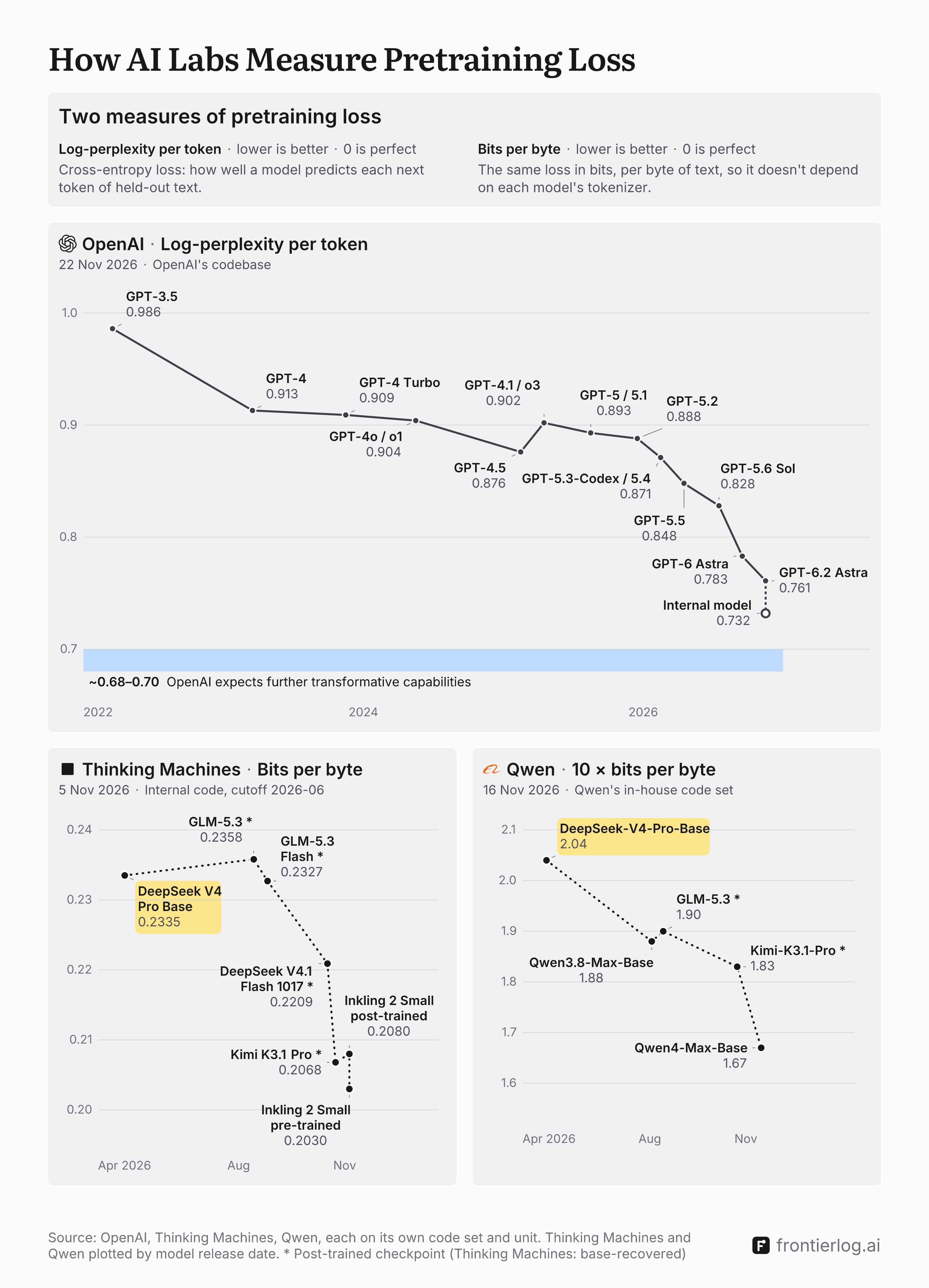
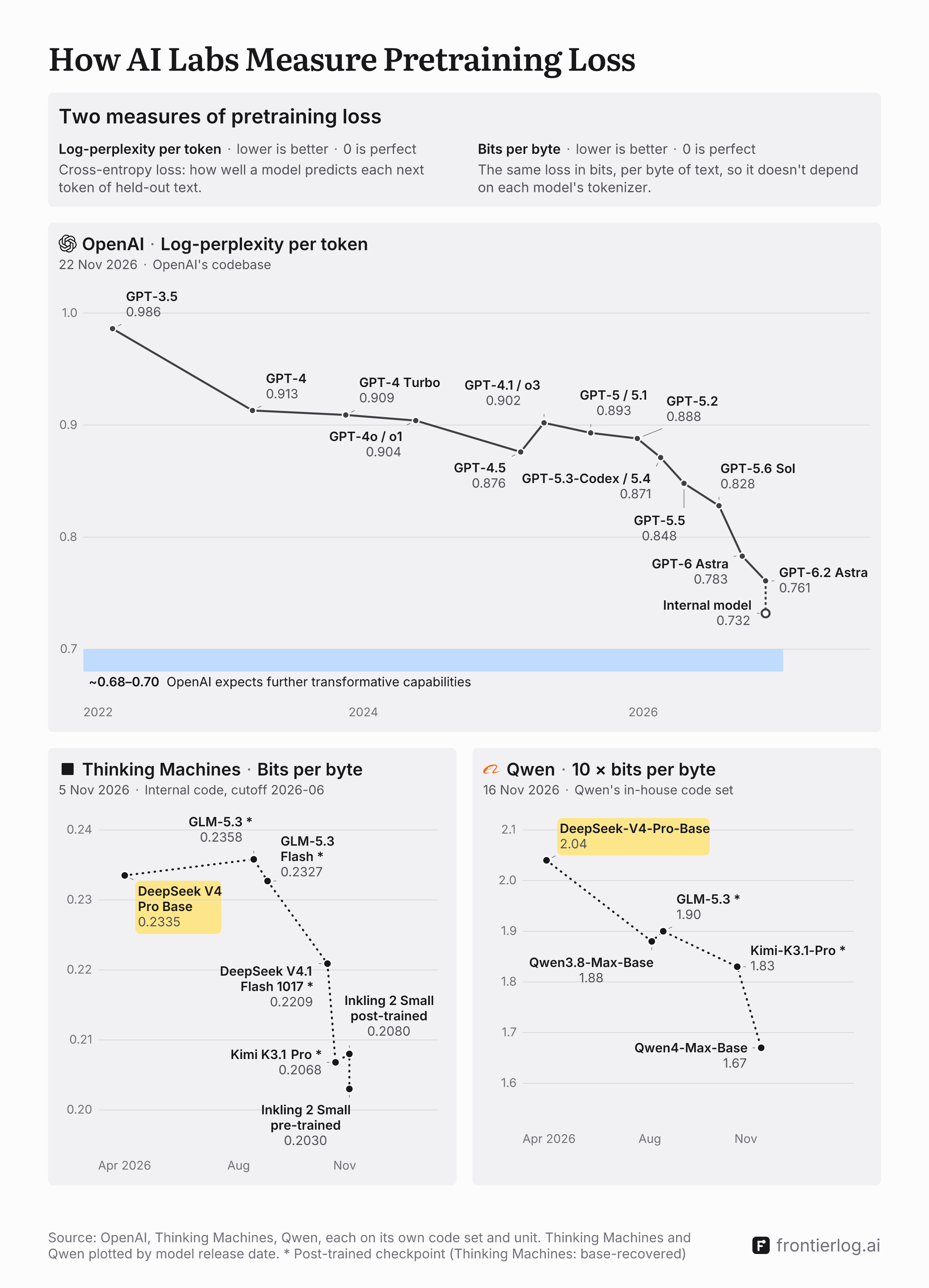
OpenAI published the pretraining loss of its models on Nov 22 and asked other labs to report the same measure. Chief scientist Jakub Pachocki's post, "Perplexity and Intelligence", charts 14 points. They run from GPT-3.5 at 0.986 to an unreleased internal model at 0.732. He argues for "establishing perplexity (or, equivalently, cross-entropy loss) as a metric to compare between model developers."
Three other labs had already published loss comparisons on their own evaluation sets: Microsoft AI on Oct 15, Thinking Machines on Nov 5 and Qwen on Nov 16.
Two units
OpenAI reports log-perplexity, which its footnote calls "the log of perplexity, also called cross-entropy loss." OpenAI defines it as cross-entropy loss: how well a model predicts each next token of held-out text. A token is a piece of text as each lab's tokenizer cuts it, so the figure depends on the tokenizer. OpenAI's data is its internal codebase at a fixed snapshot, and its chart covers only OpenAI models. It calls dataset selection "a potential challenge" for a shared metric.
Microsoft AI uses bits per byte: the same loss in bits, per byte of text, so it doesn't depend on each model's tokenizer. Microsoft AI measures held-out code on MAI's codebase. Thinking Machines reports bits per byte on its internal code with a June 2026 cutoff (Thinking Machines). Qwen reports 10 × bits per byte on Qwen's in-house code set. Lower is better for both: a lower loss means the model predicted the text better, and Thinking Machines labels its chart "lower is better" (Thinking Machines).
For its own loss, OpenAI says 0 "would correspond to being able to predict the dataset entirely deterministically." It doesn't expect that to be possible. It adds: "we do not know what the inherent entropy of the data is."
One model, three numbers
DeepSeek-V4-Pro-Base is in all three labs' bits-per-byte charts. It scores 0.2335 on Thinking Machines' code and 2.04 on Qwen's scale, or 0.204 bits per byte. It ranks sixth of seven for Thinking Machines and last of five for Qwen. Microsoft AI's chart puts it at 0.2370 on MAI's codebase, third of six (Microsoft AI).
Several rows are post-trained checkpoints. Microsoft and Thinking Machines say only those were available for these models, and Microsoft and Qwen note that post-training may affect the comparison. Thinking Machines fine-tuned such checkpoints "on a dataset of pretrain-formatted code and documents before computing log loss" and calls them base-recovered. It says the method "mostly recovers base model loss" where the base model is available to compare (Thinking Machines).
OpenAI's proposal
Pachocki lists "difficulty of comparison across labs" first among the measure's challenges: "Different developers use different evaluation datasets and train on different data mixtures." He ties earlier levels to what models could do, such as GPT-4 at ~0.91 and transformative capabilities below 0.8. Ahead, OpenAI expects further transformative capabilities in a window of ~0.68–0.70 (OpenAI).
He also proposes "common limits, based on perplexity and other measurements, that developers are committed to not crossing" (OpenAI). They would hold until the field's ability to monitor AI reaches a concrete milestone, such as "a successor to CoT monitors." Four days earlier, OpenAI said it had held back GPT-6.1 Astra.
Base-model log-perplexity
Thinking Machines: bits per byte on its internal code
Qwen: 10 × bits per byte on in-house code
Sources
- OpenAI, Nov 22, 2026Perplexity and Intelligence
- microsoft.aimicrosoft.ai/news/frontier-pre-training-at-microsoft-ai
- Thinking Machines, Nov 5, 2026Introducing Inkling 2 Small
- Alibaba, Nov 16, 2026Qwen4-Max: Your New Teammate Has Arrived
- Z.ai, Aug 14, 2026GLM-5.3: Frontier Coding with Emergent Cyber Capabilities
- DeepSeek, Apr 24, 2026DeepSeek V4 Preview Release
- Z.ai, Aug 26, 2026GLM-5.3-Flash: Frontier Intelligence, Flash Cost
- DeepSeek, Oct 17, 2026DeepSeek-V4.1-Flash-1017: Wish-Driven Programming Made Real
- Moonshot AI, Oct 24, 2026Kimi K3.1 Pro Tech Blog: Advancing Open Intelligence
- Alibaba, Aug 3, 2026Qwen3.8-Max: A New Bar for Coding and Cowork