Anthropic Rewrote Its Responsible Scaling Policy
Anthropic rewrote its Responsible Scaling Policy on Feb 24, 2026. On Nov 10 it said it met the AI R&D threshold, where its delay pledges now depend on rivals.
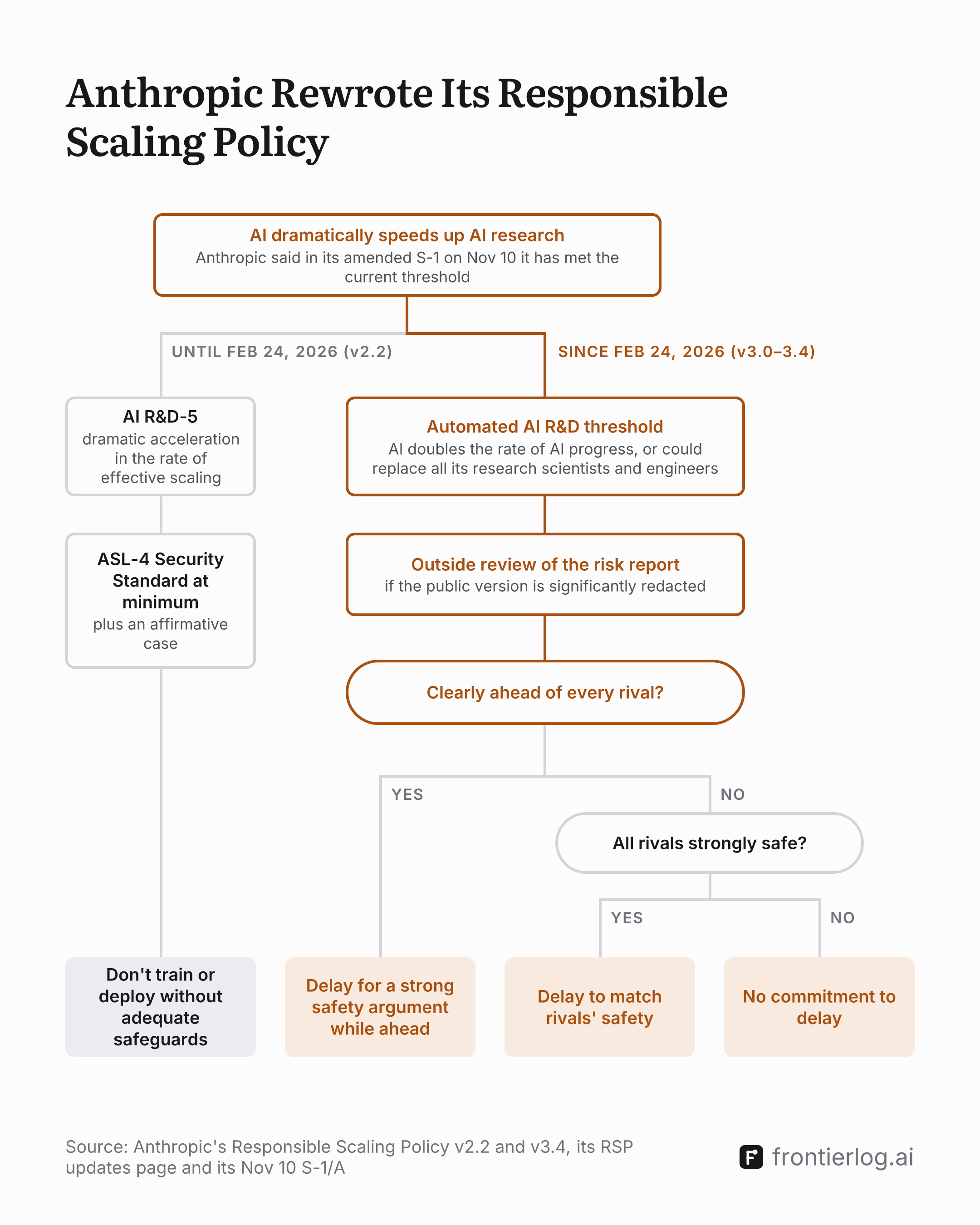
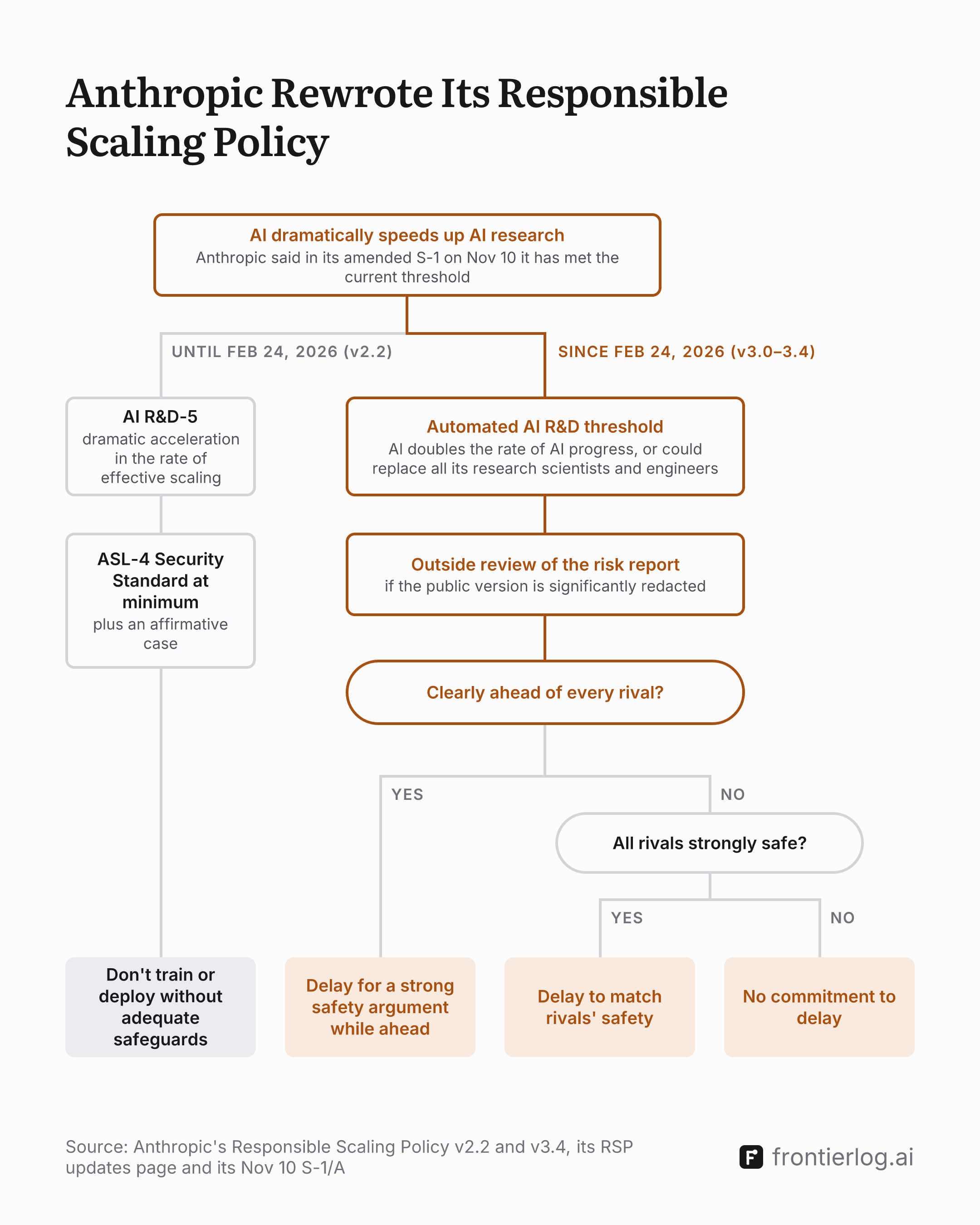
Anthropic rewrote its Responsible Scaling Policy on Feb 24, 2026. The policy sets out how the company manages catastrophic risks from its AI models. On Nov 10, its amended IPO filing said Anthropic has met the policy's threshold for AI that speeds up AI research. The rewrite changed what meeting that threshold requires.
| Rule | Until Feb 24, 2026 (v2.2) | Since Feb 24, 2026 (v3.0 to v3.4) |
|---|---|---|
| Threshold | AI R&D-5: dramatic acceleration in the rate of effective scaling | Automated AI R&D threshold: AI doubles the rate of AI progress, or could replace all its research scientists and engineers |
| Required on crossing it | ASL-4 Security Standard at minimum, plus an affirmative case | Outside review of the risk report, if the public version is significantly redacted |
| When Anthropic commits to delay | Doesn't train or deploy without adequate safeguards | Delays for a strong argument that risk is contained while clearly ahead of every rival, or delays to match rivals' safety if all rivals are strongly safe. Otherwise it doesn't commit to a delay |
The old policy put safeguards first
Version 2.2 took effect on May 14, 2025. It opened by calling the policy "a public commitment not to train or deploy models capable of causing catastrophic harm unless we have implemented safety and security measures that will keep risks below acceptable levels".
The policy had two AI research levels. AI R&D-4 covered "the ability to fully automate the work of an entry-level, remote-only Researcher at Anthropic" and required the ASL-3 Security Standard and an affirmative case. AI R&D-5 covered "the ability to cause dramatic acceleration in the rate of effective scaling". Crossing it required "at minimum, the ASL-4 Security Standard", which protects model weights from theft by state-level attackers. The policy said a higher standard might be needed, along with an affirmative case.
Under the old policy, Anthropic's RSP updates page said on Feb 10, 2026 that "Claude Opus 4.6 does not cross" AI R&D-4.
The rewrite ties delays to rivals
Version 3.0 says that "our previous RSP committed to implementing mitigations that would reduce our models' absolute risk levels to acceptable levels, without regard to whether other frontier AI developers would do the same." The new policy separates Anthropic's own plans from its recommendations for the whole industry. Of those recommendations, it says "we cannot commit to following them unilaterally".
In place of AI R&D-4 and AI R&D-5, version 3.0 has one threshold, "Automated R&D in key domains". Version 3.4 calls it the threshold for automated AI R&D. Anthropic explained the change in a post on the same day.
Under version 3.4, a model that crosses the automated AI R&D threshold counts as "highly capable". Anthropic then commits to an outside review of its Risk Report when the public version is significantly redacted. Its Appendix A sets two cases for delay.
In the first, Anthropic has "clear evidence that no other competitor will soon develop such a model". It then delays until it has "a strong argument that catastrophic risk is contained", but only "until and unless we no longer believe we have a significant lead". In the second, all competitors with such models can "make strong arguments that catastrophic risk is contained". Anthropic then delays until it matches their safety.
A third case covers a rival with a better safety measure. Anthropic will make "a significant effort" to match it but "will not necessarily delay". In other cases the policy doesn't commit to a delay. Its Appendix A says Anthropic "would strongly consider pausing development and/or deployment to improve the safety profiles of our models even in cases not covered below". Version 3.1 had added that wording on Apr 2.
Anthropic says it has met the threshold
Version 3.4, effective Jul 8, gives two ways to meet the automated AI R&D threshold. One is models that "fully substitute for our entire set of Research Scientists and Research Engineers, at competitive costs". The other is when Anthropic would "observe or expect double the rate of progress in AI aggregate capabilities", plausibly because of automated research. The doubling is compared to both the rate Anthropic would expect and "the fastest rate of extended progress we've observed in the absence of significant AI contributions to AI R&D".
Anthropic's changelog says the threshold "is intended to capture the onset of dramatic recursive self-improvement".
Anthropic's Aug 2026 Risk Report covered its models up to Jul 15. It said "We do not believe our models meet either RSP criterion for this threat model". It added that Anthropic was "less confident in this assessment than we were in prior risk reports".
It gave its reasons as evaluations that have "saturated" and "early signs of acceleration". It said Anthropic believed its internal AI R&D efforts were "significantly faster than they would be without AI assistance, but not yet by a factor of 2", though it was uncertain.
The Nov 10 filing says Anthropic made its determination "based on what we expect from future models and our overall rate of progress, rather than on what we have observed from current models". It says Anthropic is "evaluating the implications" and "will release further reports in the future". The filing doesn't say which of the Appendix A cases Anthropic believes applies. It says Anthropic's precautions have included "delaying the release of models and limiting their initial availability, such as with Mythos through Project Glasswing".
Nine versions since 2023
Anthropic lists every version of the policy on its RSP updates page and summarizes each change there. Four versions came out between Sep 2023 and May 2025. The other five came out in 2026, between Feb 24 and Jul 8.
Timeline
- Anthropic publishes RSP version 1.0Anthropic, Responsible Scaling Policy updates page
- Anthropic publishes RSP version 2.0, adding capability thresholdsAnthropic, Responsible Scaling Policy, version 3.4 (PDF)
- Anthropic publishes version 2.1, splitting the AI R&D threshold into two levelsAnthropic, Responsible Scaling Policy updates page
- Anthropic publishes version 2.2, narrowing the ASL-3 Security Standard's scopeAnthropic, Responsible Scaling Policy updates page
- Anthropic says Claude Opus 4.6 does not cross AI R&D-4Anthropic, Responsible Scaling Policy updates page
- Anthropic publishes version 3.0, a full rewriteAnthropic, Responsible Scaling Policy updates page
- Anthropic publishes version 3.1, clarifying the AI R&D thresholdAnthropic, Responsible Scaling Policy updates page
- Anthropic publishes version 3.2, giving the Long-Term Benefit Trust a say in outside reviewAnthropic, Responsible Scaling Policy updates page
- Anthropic publishes version 3.3, revising the chemical and biological weapons thresholdAnthropic, Responsible Scaling Policy updates page
- Anthropic publishes version 3.4, revising the automated R&D thresholdAnthropic, Responsible Scaling Policy updates page
- Anthropic says in its Risk Report that its models don't meet the automated AI R&D thresholdAnthropic, Risk Report (PDF)
- Anthropic says in its amended IPO filing that it has met the AI R&D thresholdAnthropic, SEC filing, Form S-1/A
Sources
- Anthropic, Responsible Scaling Policy updates pageanthropic.com/rsp-updates
- Anthropic, Responsible Scaling Policy, version 2.2 (PDF), May 14, 2025assets.claude.com/872c653b2d0501d6ab44cf87f43e1dc4853e4d37.pdf
- Anthropic, Responsible Scaling Policy, version 3.0 (PDF), Feb 24, 2026anthropic.com/responsible-scaling-policy/rsp-v3-0
- Anthropic, Responsible Scaling Policy, version 3.4 (PDF), Jul 8, 2026assets.claude.com/0bacdc8440ea96e62a8766d99ebe1d4eea6d5f3a.pdf
- Anthropic, blog post, Feb 24, 2026Responsible Scaling Policy Version 3.0
- Anthropic, SEC filing, Form S-1/A, Nov 10, 2026sec.gov/Archives/edgar/data/2130357/000162828026072484/anthropicpbc-sx1ax2.htm
- Anthropic, Risk Report (PDF), Aug 14, 2026anthropic.com/aug-2026-risk-report