Frontier Log

How Humanity's First Exam Works

Google DeepMind's Humanity's First Exam counts a family of four prompts only when a model answers all of them right every time. This is how that score works.
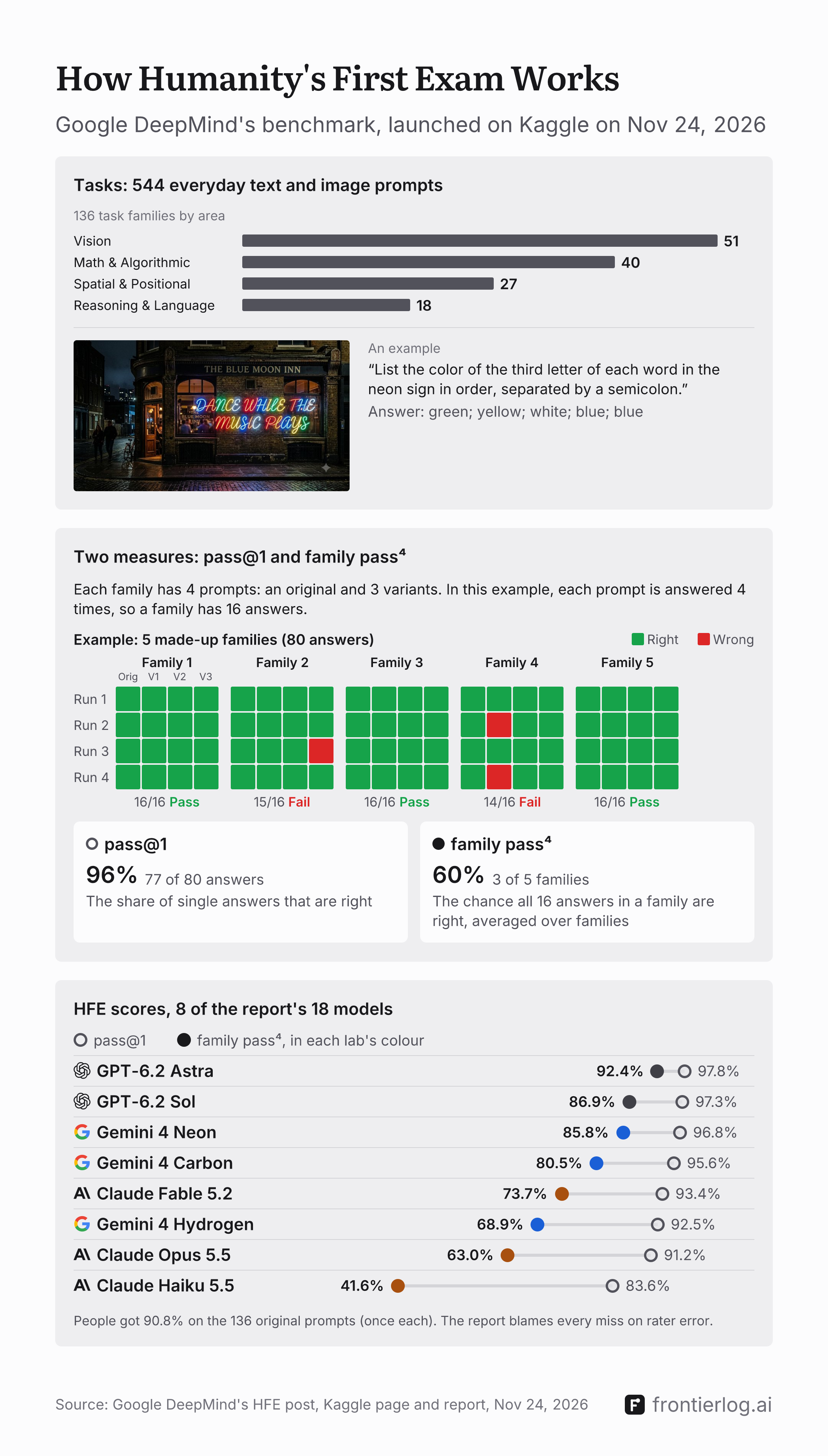
How Humanity's First Exam works: Google DeepMind's benchmark, launched on Kaggle on Nov 24, 2026, in three blocks. The first, "Tasks: 544 everyday text and image prompts". 136 task families by area, as bars: Vision 51, Math & Algorithmic 40, Spatial & Positional 27, Reasoning & Language 18. An example: a photo of a pub with a multicoloured neon sign and the prompt "List the color of the third letter of each word in the neon sign in order, separated by a semicolon." Its answer lists five colours: green, yellow, white, blue and blue. The second, "Two measures: pass@1 and family pass⁴", says each family has 4 prompts, an original and 3 variants, and that in this example each prompt is answered 4 times, so a family has 16 answers. "Example: 5 made-up families (80 answers)", with a key of green for right and red for wrong, shows five 4 by 4 grids. Family 1's columns are labelled Orig, V1, V2 and V3 and its rows Run 1 to Run 4. Families 1, 3 and 5 are all right: 16/16, Pass. Family 2 misses run 3 of V3: 15/16, Fail. Family 4 misses runs 2 and 4 of V1: 14/16, Fail. Two cards follow. pass@1, with an open dot: 96%, 77 of 80 answers, the share of single answers that are right. family pass⁴, with a filled dot: 60%, 3 of 5 families, the chance all 16 answers in a family are right, averaged over families. The third, HFE scores for 8 of the report's 18 models, pass@1 then family pass⁴: GPT-6.2 Astra 97.8% and 92.4%, GPT-6.2 Sol 97.3% and 86.9%, Gemini 4 Neon 96.8% and 85.8%, Gemini 4 Carbon 95.6% and 80.5%, Claude Fable 5.2 93.4% and 73.7%, Gemini 4 Hydrogen 92.5% and 68.9%, Claude Opus 5.5 91.2% and 63.0%, Claude Haiku 5.5 83.6% and 41.6%. Under the chart: People got 90.8% on the 136 original prompts (once each). The report blames every miss on rater error.
Google DeepMind's technical report, Nov 24, 2026, for 8 of its 18 models: GPT-6.2 Astra scores 97.8% on pass@1 and 92.4% on family pass⁴, and Claude Haiku 5.5 83.6% and 41.6%. The five families in the second block are a made-up example. Download

Google DeepMind launched Humanity's First Exam on Kaggle on Nov 24, 2026, "to measure how reliably LLMs answer straightforward, everyday questions". Its post says most benchmarks measure what models can do in complex math, coding and science. Humanity's First Exam asks whether a model solves everyday tasks, and slight variations of them, every single time. A technical report and a live leaderboard came out the same day.

Everyday prompts in families of four

The benchmark has 544 everyday text and image prompts in 136 families, across four groups: Vision (51 families), Math & Algorithmic (40), Spatial & Positional (27) and Reasoning & Language (18). A family is 4 prompts: an original and 3 variants that rename items, reorder the wording or change the image. Four people tried each candidate original without tools, and DeepMind kept a family only if at least 3 of them got it right, the Kaggle page says.

DeepMind wrote every prompt from scratch and kept those that made at least one frontier model answer wrongly when they were written. 112 prompts (28 families) are public under CC BY 4.0, and the other 432 are held back. The neon-sign task in the image is from the public set, as the report's Figure 2 prints it: "List the color of the third letter of each word in the neon sign in order, separated by a semicolon." Its answer lists five colours: green, yellow, white, blue and blue.

On the 136 originals DeepMind kept, people's answers were right 90.8% of the time, the report says. Their median solve time was 1.0 minute on the Vision and Spatial & Positional originals. The report doesn't measure people's family pass⁴.

One wrong answer fails a family

Each prompt is answered 6 times without tools, and Gemini 3.1 Pro grades each final answer as right or wrong. pass@1 is the share of single answers that are right. Family pass⁴ draws 4 answers from each of a family's 4 prompts, 16 in all. It is the chance that all 16 are right, averaged over the 136 families. A prompt answered right 5 times in 6 scores 5 in 15 on its own, and one answered right 3 times or fewer scores 0, the Kaggle page says.

The five families in the image are a made-up example of that rule. Of their 80 answers, 77 are right, so pass@1 is 96%. Each family's answers here are fixed, so its chance of 16 right answers is 1 or 0. Only 3 of the 5 families have all 16 right, so family pass⁴ is 60%.

Where pass⁴ comes from, and how answers are judged

DeepMind didn't invent the measure. Its report says that for pass⁴ "we follow Yao et al. (2024)", the authors of τ-bench, a Sierra benchmark posted on Jun 17, 2024. That paper proposed "a new metric (pass^k) to evaluate the reliability of agent behavior over multiple trials". Humanity's First Exam applies the same rule to a family's 4 prompts together, as family pass⁴.

The Gemini 3.1 Pro judge runs at temperature 0. It grades only the final answer in the model's visible response, because the model's internal reasoning is stripped out first. The report lists the judge's four equivalence rules. An answer choice may sit in brackets, a number may be written as a word, a time may be given in other units, and a rubric answer must meet every criterion.

When the report audited every failed prompt with Claude Fable 5.2, about 3% of the answers marked wrong were flagged as possibly correct or defensible.

Near 100% once, lower every time

In the report's Table 4, the top five of 18 models score 96% to 98% on pass@1. Family pass⁴ peaks at 92.4% for GPT-6.2 Astra. The report says Claude Opus 5.5 trails it "by 6.6 pp on pass@1, yet by 29.4 pp on family pass4". Averaged across models, the report says, roughly half of the gap between family pass⁴ and 100% comes from prompts a model always fails, and half from prompts it gets right on only some draws.

The report used AI models to sort the failures. It puts 73% of wrong answers down to visual perception, such as misjudging where something is or miscounting objects. Its full table, including Claude Fable 5.2 at 73.7% and GPT-6 Luna at 25.6%, is below.

The leaderboard's figures differ

Kaggle's leaderboard reruns 16 models in its own harness and ranks GPT-6.2 Astra first at 90.7%, against 92.4% in the report. It runs Gemini 4 Neon and Gemini 4 Hydrogen at high effort, where the report uses xhigh, and doesn't list the Claude Fable models. Claude Opus 5.5 scores 70.0% there, against 63.0% in the report. The Kaggle page puts that down to fewer safety refusals (0.18% against 1.62%) and the variance of sampling.

The report scores a refusal as a failure. Without refusals and cut-off answers, Opus 5.5 would score 67.4% in the report, the Kaggle page says. The page also says its scores closely track the report's, with a rank correlation of 0.98 and differences inside the 95% intervals.

The image draws the report's figures, because the leaderboard doesn't show pass@1.

Through Dec 15, a Kaggle competition invites anyone to submit everyday questions that "today's models still get wrong", DeepMind's post says.

Technical report, pass@1

ModelValueSources
Gemini 3.6 Flash and 3.5 Flash-LiteGemini 3.6 Flash (high), ±3.483.8%Humanity’s First Exam: Measuring the Reliability Floor of LLMs
Gemini 3.6 Flash and 3.5 Flash-LiteGemini 3.5 Flash-Lite (high), ±4.468.7%Humanity’s First Exam: Measuring the Reliability Floor of LLMs
Claude Fable 5.1 and Mythos 5.1Claude Fable 5.1 (max), ±3.185.7%Humanity’s First Exam: Measuring the Reliability Floor of LLMs
Gemini 3.8 Flash and 3.8 Flash CyberGemini 3.8 Flash (high), ±3.287.1%Humanity’s First Exam: Measuring the Reliability Floor of LLMs
GPT-6 AstraGPT-6 Astra (xhigh), ±1.696.8%Humanity’s First Exam: Measuring the Reliability Floor of LLMs
Claude Opus 5.5Claude Opus 5.5 (max), ±2.691.2%Humanity’s First Exam: Measuring the Reliability Floor of LLMs
GPT-6 Sol and LunaGPT-6 Luna (xhigh), ±4.174.8%Humanity’s First Exam: Measuring the Reliability Floor of LLMs
Claude Sonnet 5.5Claude Sonnet 5.5 (max), ±2.491.7%Humanity’s First Exam: Measuring the Reliability Floor of LLMs
GPT-6.1 SolGPT-6.1 Sol (xhigh), ±1.796.1%Humanity’s First Exam: Measuring the Reliability Floor of LLMs
Gemini 4 ArgonGemini 4 Argon (high), ±2.194.1%Humanity’s First Exam: Measuring the Reliability Floor of LLMs
Claude Haiku 5.5Claude Haiku 5.5 (max), ±3.383.6%Humanity’s First Exam: Measuring the Reliability Floor of LLMs
GPT-6.1 TerraGPT-6.1 Terra (xhigh), ±2.194.7%Humanity’s First Exam: Measuring the Reliability Floor of LLMs
Gemini 4 CarbonGemini 4 Carbon (high), ±1.795.6%Humanity’s First Exam: Measuring the Reliability Floor of LLMs
Claude Fable 5.2 and Mythos 5.2Claude Fable 5.2 (max), ±2.293.4%Humanity’s First Exam: Measuring the Reliability Floor of LLMs
Gemini 4 HydrogenGemini 4 Hydrogen (xhigh), ±2.492.5%Humanity’s First Exam: Measuring the Reliability Floor of LLMs
GPT-6.2 Astra and SolGPT-6.2 Astra (xhigh), ±1.597.8%Humanity’s First Exam: Measuring the Reliability Floor of LLMs
GPT-6.2 Astra and SolGPT-6.2 Sol (xhigh), ±1.597.3%Humanity’s First Exam: Measuring the Reliability Floor of LLMs
Gemini 4 NeonGemini 4 Neon (xhigh), ±1.596.8%Humanity’s First Exam: Measuring the Reliability Floor of LLMs

Technical report, family pass⁴

ModelValueSources
Gemini 3.6 Flash and 3.5 Flash-LiteGemini 3.6 Flash (high), ±8.044.7%Humanity’s First Exam: Measuring the Reliability Floor of LLMs
Gemini 3.6 Flash and 3.5 Flash-LiteGemini 3.5 Flash-Lite (high), ±6.018.6%Humanity’s First Exam: Measuring the Reliability Floor of LLMs
Claude Fable 5.1 and Mythos 5.1Claude Fable 5.1 (max), ±8.049.7%Humanity’s First Exam: Measuring the Reliability Floor of LLMs
Gemini 3.8 Flash and 3.8 Flash CyberGemini 3.8 Flash (high), ±8.156.8%Humanity’s First Exam: Measuring the Reliability Floor of LLMs
GPT-6 AstraGPT-6 Astra (xhigh), ±5.883.4%Humanity’s First Exam: Measuring the Reliability Floor of LLMs
Claude Opus 5.5Claude Opus 5.5 (max), ±7.663.0%Humanity’s First Exam: Measuring the Reliability Floor of LLMs
GPT-6 Sol and LunaGPT-6 Luna (xhigh), ±6.725.6%Humanity’s First Exam: Measuring the Reliability Floor of LLMs
Claude Sonnet 5.5Claude Sonnet 5.5 (max), ±7.767.6%Humanity’s First Exam: Measuring the Reliability Floor of LLMs
GPT-6.1 SolGPT-6.1 Sol (xhigh), ±6.479.1%Humanity’s First Exam: Measuring the Reliability Floor of LLMs
Gemini 4 ArgonGemini 4 Argon (high), ±6.876.6%Humanity’s First Exam: Measuring the Reliability Floor of LLMs
Claude Haiku 5.5Claude Haiku 5.5 (max), ±7.941.6%Humanity’s First Exam: Measuring the Reliability Floor of LLMs
GPT-6.1 TerraGPT-6.1 Terra (xhigh), ±6.976.4%Humanity’s First Exam: Measuring the Reliability Floor of LLMs
Gemini 4 CarbonGemini 4 Carbon (high), ±6.480.5%Humanity’s First Exam: Measuring the Reliability Floor of LLMs
Claude Fable 5.2 and Mythos 5.2Claude Fable 5.2 (max), ±7.373.7%Humanity’s First Exam: Measuring the Reliability Floor of LLMs
Gemini 4 HydrogenGemini 4 Hydrogen (xhigh), ±7.568.9%Humanity’s First Exam: Measuring the Reliability Floor of LLMs
GPT-6.2 Astra and SolGPT-6.2 Astra (xhigh), ±4.392.4%Humanity’s First Exam: Measuring the Reliability Floor of LLMs
GPT-6.2 Astra and SolGPT-6.2 Sol (xhigh), ±5.286.9%Humanity’s First Exam: Measuring the Reliability Floor of LLMs
Gemini 4 NeonGemini 4 Neon (xhigh), ±5.885.8%Humanity’s First Exam: Measuring the Reliability Floor of LLMs

Kaggle leaderboard, family pass⁴

ModelValueSources
Gemini 3 FlashGemini 3 Flash Preview (High), ±7.533.4%Humanity's First Exam (HFE) Leaderboard | Kaggle
Gemini 3.1 Flash-LiteGemini 3.1 Flash-Lite Preview (High), ±6.218.5%Humanity's First Exam (HFE) Leaderboard | Kaggle
GPT-5.6GPT-5.6 Sol (Max), ±7.956.5%Humanity's First Exam (HFE) Leaderboard | Kaggle
Gemini 3.8 Flash and 3.8 Flash CyberGemini 3.8 Flash (High), ±8.156.1%Humanity's First Exam (HFE) Leaderboard | Kaggle
GPT-6 AstraGPT-6 Astra (Xhigh), ±5.984.0%Humanity's First Exam (HFE) Leaderboard | Kaggle
Claude Opus 5.5Claude Opus 5.5 (Max), ±7.470.0%Humanity's First Exam (HFE) Leaderboard | Kaggle
Claude Sonnet 5.5Claude Sonnet 5.5 (Max), ±7.765.6%Humanity's First Exam (HFE) Leaderboard | Kaggle
GPT-6.1 SolGPT-6.1 Sol (Xhigh), ±6.181.7%Humanity's First Exam (HFE) Leaderboard | Kaggle
Gemini 4 ArgonGemini 4 Argon (High), ±6.876.6%Humanity's First Exam (HFE) Leaderboard | Kaggle
Claude Haiku 5.5Claude Haiku 5.5 (Max), ±7.942.5%Humanity's First Exam (HFE) Leaderboard | Kaggle
GPT-6.1 TerraGPT-6.1 Terra (Xhigh), ±6.778.1%Humanity's First Exam (HFE) Leaderboard | Kaggle
Gemini 4 CarbonGemini 4 Carbon (High), ±6.679.2%Humanity's First Exam (HFE) Leaderboard | Kaggle
Gemini 4 HydrogenGemini 4 Hydrogen (High), ±7.370.5%Humanity's First Exam (HFE) Leaderboard | Kaggle
GPT-6.2 Astra and SolGPT-6.2 Astra (Xhigh), ±4.790.7%Humanity's First Exam (HFE) Leaderboard | Kaggle
GPT-6.2 Astra and SolGPT-6.2 Sol (Xhigh), ±5.187.5%Humanity's First Exam (HFE) Leaderboard | Kaggle
Gemini 4 NeonGemini 4 Neon (High), ±5.785.6%Humanity's First Exam (HFE) Leaderboard | Kaggle

Sources

Models

Related

Tags