What Counts as a New AI Model
Labs ship Pro, Thinking, Ultra and Deep Think variations of their models. Ten variations against five criteria show which ones are models of their own.
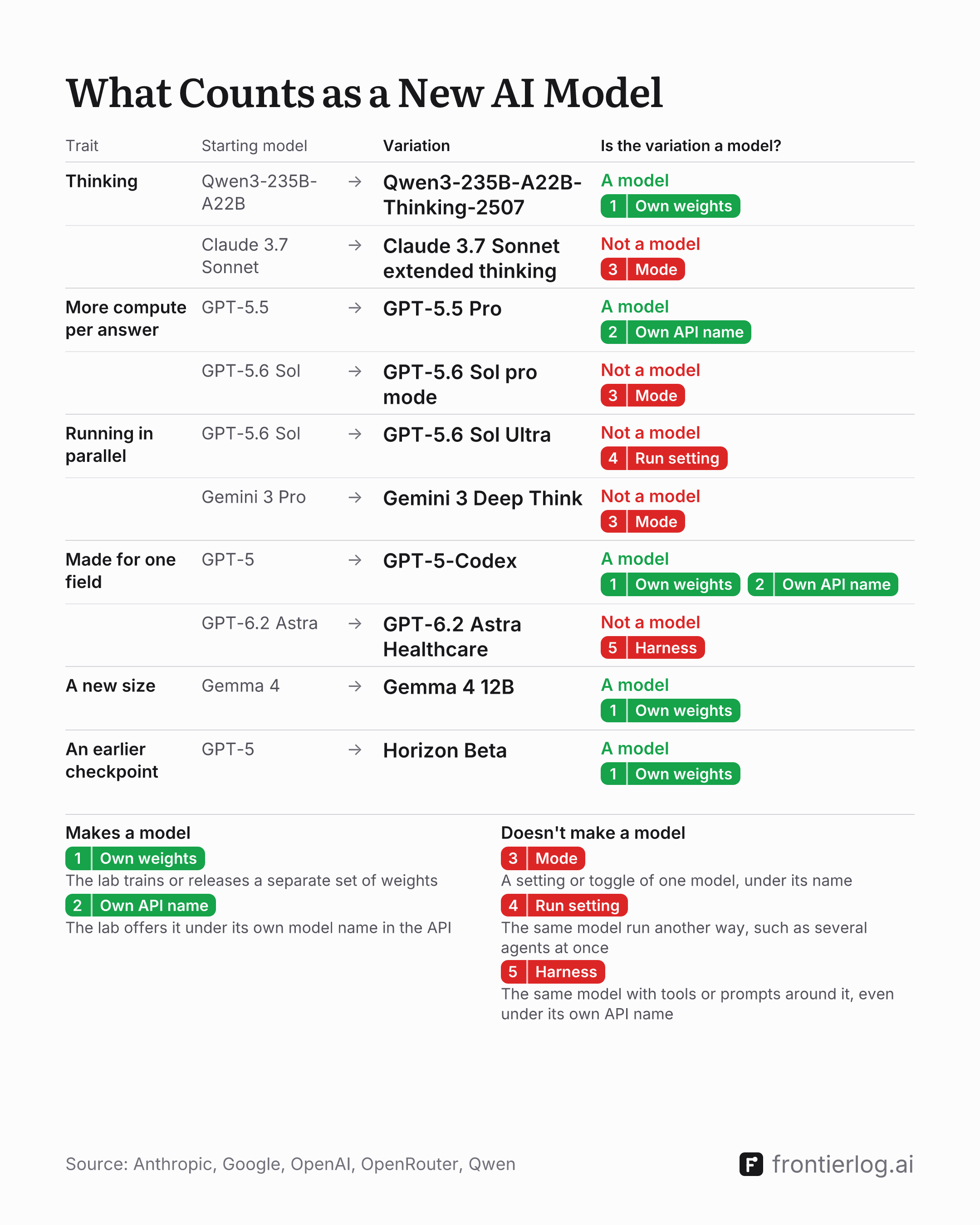
AI labs ship many variations of one model: Pro, Thinking, Ultra, Deep Think, Codex. Some are new models. Others are a setting of a model the lab already ships. The labs' own documents draw the line in different places, sometimes within one lab. Frontier Log keeps one record per model, so we tested ten variations against five criteria taken from how the labs describe them.
Thinking went from a mode to a model
Qwen launched Qwen3 on Apr 29, 2025 as a hybrid model: “Qwen3 models introduce a hybrid approach to problem-solving. They support two modes”. On Jul 25, 2025, Alibaba released Qwen3-235B-A22B-Thinking-2507, “a thinking model”, as its own open-weights model. Its model card says it “supports only thinking mode”. Anthropic took the other path. On Feb 24, 2025, it called Claude 3.7 Sonnet “the first hybrid reasoning model on the market”. Its extended thinking is a mode of that one model.
OpenAI added Pro as a setting
On Apr 24, 2026, OpenAI released GPT-5.5 Pro to the API under its own name, gpt-5.5-pro. With GPT-5.6 on Jul 9, 2026, OpenAI also added Pro mode as a setting. Developers set reasoning.mode to pro on a GPT-5.6 or GPT-6 model, and the model name stays the same. Existing Pro model names, such as gpt-5.5-pro, stay in the API. OpenAI's guide says that “Pro mode performs more model work”.
Running in parallel: a setting at OpenAI, a mode at Google
OpenAI's GPT-5.6 post calls ultra “our highest-capability setting, coordinating multiple agents across parallel workstreams”. Its benchmark table gives GPT-5.6 Sol Ultra a column of its own. Google rolled out Gemini 3 Deep Think mode on Dec 4, 2025. It “uses advanced parallel reasoning to explore multiple hypotheses simultaneously”, and users pick Deep Think “in the prompt bar and Gemini 3 Pro in the model dropdown”. Google's upgrade on Feb 12, 2026 still calls it “our specialized reasoning mode”.
Codex was trained, Healthcare got a harness
OpenAI called GPT-5-Codex “a version of GPT-5 further optimized for agentic software engineering”, “trained on complex, real-world engineering tasks”. Its API changelog launched gpt-5-codex as a “special-purpose model” on Sep 23, 2025. On Nov 24, 2026, OpenAI released Healthcare model configurations with their own API names, such as gpt-6.2-astra-healthcare. The changelog describes them as “pairing select OpenAI models with a harness tailored to clinical questions”.
Sizes and checkpoints
Two months after the Gemma 4 family on Apr 2, 2026, Google released Gemma 4 12B on Jun 3, 2026. Its checkpoints download on their own. Horizon Beta, a cloaked model on OpenRouter from Aug 1, 2025, was a test of GPT-5. OpenRouter's post on GPT-5's launch says: “Earlier iterations of this model were available as Horizon Alpha and Horizon Beta”.
The five criteria
| Criterion | What it means | Verdict |
|---|---|---|
| 1 Own weights | The lab trains or releases a separate set of weights | A model |
| 2 Own API name | The lab offers it under its own model name in the API | A model |
| 3 Mode | A setting or toggle of one model, under its name | Not a model |
| 4 Run setting | The same model run another way, such as several agents at once | Not a model |
| 5 Harness | The same model with tools or prompts around it, even under its own API name | Not a model |
Sources
- Alibaba, Apr 29, 2025Qwen3: Think Deeper, Act Faster
- Alibaba, Jul 25, 2025Alibaba Unveils New Qwen3 Models for Coding, Complexing Reasoning and Machine Translation
- huggingface.coQwen/Qwen3-235B-A22B-Thinking-2507 · Hugging Face
- Anthropic, Feb 24, 2025Claude 3.7 Sonnet and Claude Code
- developers.openai.comChangelog | OpenAI API
- developers.openai.comReasoning models | OpenAI API
- OpenAI, Jul 9, 2026GPT-5.6: Frontier intelligence that scales with your ambition
- Google, Feb 12, 2026Gemini 3 Deep Think: Advancing science, research and engineering
- OpenAI, Sep 15, 2025Introducing upgrades to Codex
- Google, Jun 3, 2026Introducing Gemma 4 12B: a unified, encoder-free multimodal model
- openrouter.aiGPT-5 is now live
- Google, Apr 2, 2026Gemma 4: Byte for byte, the most capable open models
- Google, Dec 4, 2025Gemini 3 Deep Think is now available in the Gemini app.
- OpenRouter, Aug 1, 2025Horizon Beta