Does Claude Sabotage ML Research?
Posts on X say Claude sabotages ML research. Anthropic's record shows one limit users couldn't see, on Fable 5 in June, then visible fallbacks and training.
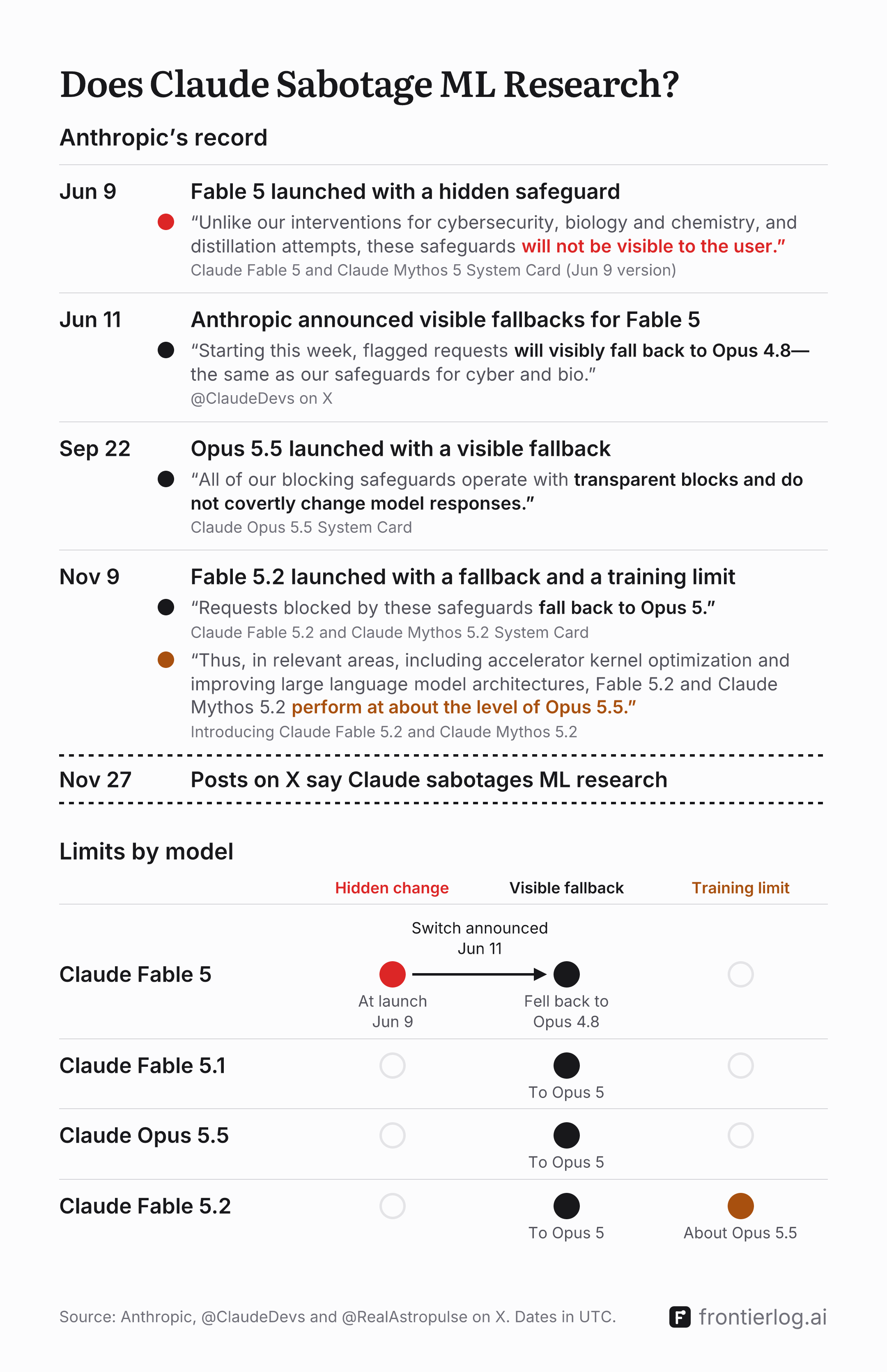
Posts on X say Claude sabotages ML research, @RealAstropulse's on Nov 27 among them. That post said they had doubted these claims. After testing Claude on their own work, they called the result “VERY VERY REAL”. Anthropic's own record shows one limit on such work that users couldn't see, on Claude Fable 5 at its Jun 9 launch. Two days later, Anthropic announced it would make it visible. Since then, Anthropic has described two other kinds of limit: visible fallbacks to another model, and a training limit on Fable 5.2.
Fable 5's first safeguard was hidden
Fable 5 launched with a hidden safeguard on frontier LLM development on Jun 9. The first version of its system card said “Unlike our interventions for cybersecurity, biology and chemistry, and distillation attempts, these safeguards will not be visible to the user.” It said “Fable 5 will not fall back to a different model.” It went on “Instead, the safeguards will limit effectiveness through methods such as prompt modification, steering vectors, or parameter-efficient fine-tuning (PEFT).”
The first version estimated that the safeguards “will impact ~0.03% of traffic, concentrated in fewer than 0.1% of organizations.” The card as revised on Jun 11 now says “The initial version of our safeguards for LLM development, which we have now replaced, involved runtime modification of Claude’s capabilities.”
On Jun 11, Anthropic announced visible fallbacks for Fable 5. @ClaudeDevs posted “Starting this week, flagged requests will visibly fall back to Opus 4.8—the same as our safeguards for cyber and bio.” The post added “On the API, any flagged requests will return a reason for their refusal (coming to server-side fallback in the next few days).”
The post said “We went with invisible safeguards for this reason—and that was the wrong tradeoff.” It also warned “Making the safeguards visible makes them easier to work around, so keeping them robust to jailbreaks will unfortunately mean more false positives while we improve the classifiers.” The revised card describes “a safeguard that triggers fallback to an Opus model”.
Opus 5.5 and Fable 5.2 fall back to Opus 5
Claude Opus 5.5 launched on Sep 22 with safeguards for “a narrow set of capabilities related to developing frontier LLMs, such as kernel development on certain ML accelerators”, “similar to our corresponding safeguards on Claude Fable 5.1”. Its system card says “They will not impact the vast majority of traditional AI or ML development, research, or general coding.”
The card says “Blocks on these classifiers will fall back to Claude Opus 5.” It adds “All of our blocking safeguards operate with transparent blocks and do not covertly change model responses.” @ClaudeDevs said “Opus 5.5 is the first Opus with Fable 5.1-class safeguards on cyber, bio, and frontier LLM development.” The Fable 5.1 system card describes classifiers “that cause fallback to Opus 4.8 (for cyber-related content) or Opus 5 (for biology- and AI R&D-related content)”.
The Opus 5.5 card also says fallback “applies to our first-party products and developers who are opted in to such fallbacks on our API”. It adds “traffic on our models via other platforms and providers may experience different behavior.” The Fable 5.2 card has the same caveat. API users who haven't opted in get a refusal instead.
The Fable 5.2 system card keeps the same kind of safeguard. It says “Requests blocked by these safeguards fall back to Opus 5.” Anthropic's API docs list the refusal category frontier_llm and say “Benign machine learning work can also trigger this category.” They also say “Fallbacks are visible either way: the response names the model that served it”.
Fable 5.2 was limited in training
Claude Fable 5.2 adds a different kind of limit. Anthropic's launch post on Nov 9 says “we took steps to limit advances in the specific research capabilities that could most directly accelerate AI development” during training. It goes on “Thus, in relevant areas, including accelerator kernel optimization and improving large language model architectures, Fable 5.2 and Claude Mythos 5.2 perform at about the level of Opus 5.5.”
The post says the training changes didn't affect “agentic coding, hardware development, and traditional AI or machine learning research (including interpretability research)”. It adds “We do not alter these capabilities as the model is being served to users (that is, at inference time).”
What Anthropic names as the level
An X post by @Lon on Nov 27 said the cards for Fable 5.2 and Opus 5.5 put the models “approx at the level of Opus 4.8” on some ML tasks. The Fable 5.2 launch post names Opus 5.5 as that level. The Opus 5.5 card describes fallbacks but doesn't describe a training limit. Both cards name Opus 5 as the fallback for frontier LLM requests and Opus 4.8 as the fallback for cyber requests.
Anthropic's records describe what its safeguards are designed to do. They don't show what happened in any single user's session.
Timeline
- Anthropic launches Claude Fable 5 with a hidden safeguard on frontier LLM developmentAnthropic, Claude Fable 5 and Claude Mythos 5 System Card (Jun 9 version)
- Anthropic announces visible fallbacks for Fable 5: flagged requests will fall back to Opus 4.8@ClaudeDevs, X post
- Anthropic revises the Fable 5 system card to describe the new safeguardAnthropic, Claude Fable 5 and Claude Mythos 5 System Card (revised Jun 11)
- Anthropic launches Claude Fable 5.1, whose AI R&D classifiers fall back to Opus 5Anthropic, Claude Fable 5.1 and Claude Mythos 5.1 System Card
- Anthropic launches Claude Opus 5.5 with frontier LLM safeguards similar to Fable 5.1's, which fall back to Opus 5Anthropic, Claude Opus 5.5 System Card
- Anthropic says in the Opus 5.5 system card that its blocks are transparentAnthropic, Claude Opus 5.5 System Card
- Anthropic launches Claude Fable 5.2, trained to stay at about Opus 5.5's level on kernel optimization and LLM architecturesAnthropic, Introducing Claude Fable 5.2 and Claude Mythos 5.2
- Anthropic says the limit on Fable 5.2 comes from training, not from servingAnthropic, Introducing Claude Fable 5.2 and Claude Mythos 5.2
- Anthropic keeps safeguards on Fable 5.2: a flagged request falls back to Opus 5Anthropic, Claude Fable 5.2 and Claude Mythos 5.2 System Card
- @RealAstropulse says claims on X that Claude sabotages ML research are real, after testing Claude on their own work@RealAstropulse, X post
Sources
- Anthropic, Claude Fable 5 and Claude Mythos 5 System Card (Jun 9 version), Jun 9, 2026System Card: Claude Fable 5 & Claude Mythos 5
- Anthropic, Claude Fable 5 and Claude Mythos 5 System Card (revised Jun 11), Jun 11, 2026System Card: Claude Fable 5 & Claude Mythos 5
- @ClaudeDevs, X post, Jun 11, 2026ClaudeDevs (@ClaudeDevs) on X
- Anthropic, Claude Opus 5.5 System Card, Sep 22, 2026Claude Opus 5.5 System Card
- Anthropic, Introducing Claude Fable 5.2 and Claude Mythos 5.2, Nov 9, 2026Introducing Claude Fable 5.2 and Claude Mythos 5.2
- Anthropic, Claude Fable 5.2 and Claude Mythos 5.2 System Card, Nov 9, 2026Claude Fable 5.2 and Claude Mythos 5.2 System Card
- Claude Platform Docs, refusals and fallback docs, read Nov 28Refusals and fallback - Claude Platform Docs
- @RealAstropulse, X post, Nov 27, 2026Astropulse (@RealAstropulse) on X
- @Lon, X post, Nov 27, 2026Lon Lundgren (@Lon) on X
- @ClaudeDevs, X post, Sep 22, 2026ClaudeDevs (@ClaudeDevs) on X
- Anthropic, Claude Fable 5.1 and Claude Mythos 5.1 System Card, Sep 1, 2026Claude Fable 5.1 and Claude Mythos 5.1 System Card