Claude Fable 5.2's New Habits
Anthropic says Claude Fable 5.2 thinks from medium effort up when told not to, had subagents check its work in a coding product and can put a reviewer first.
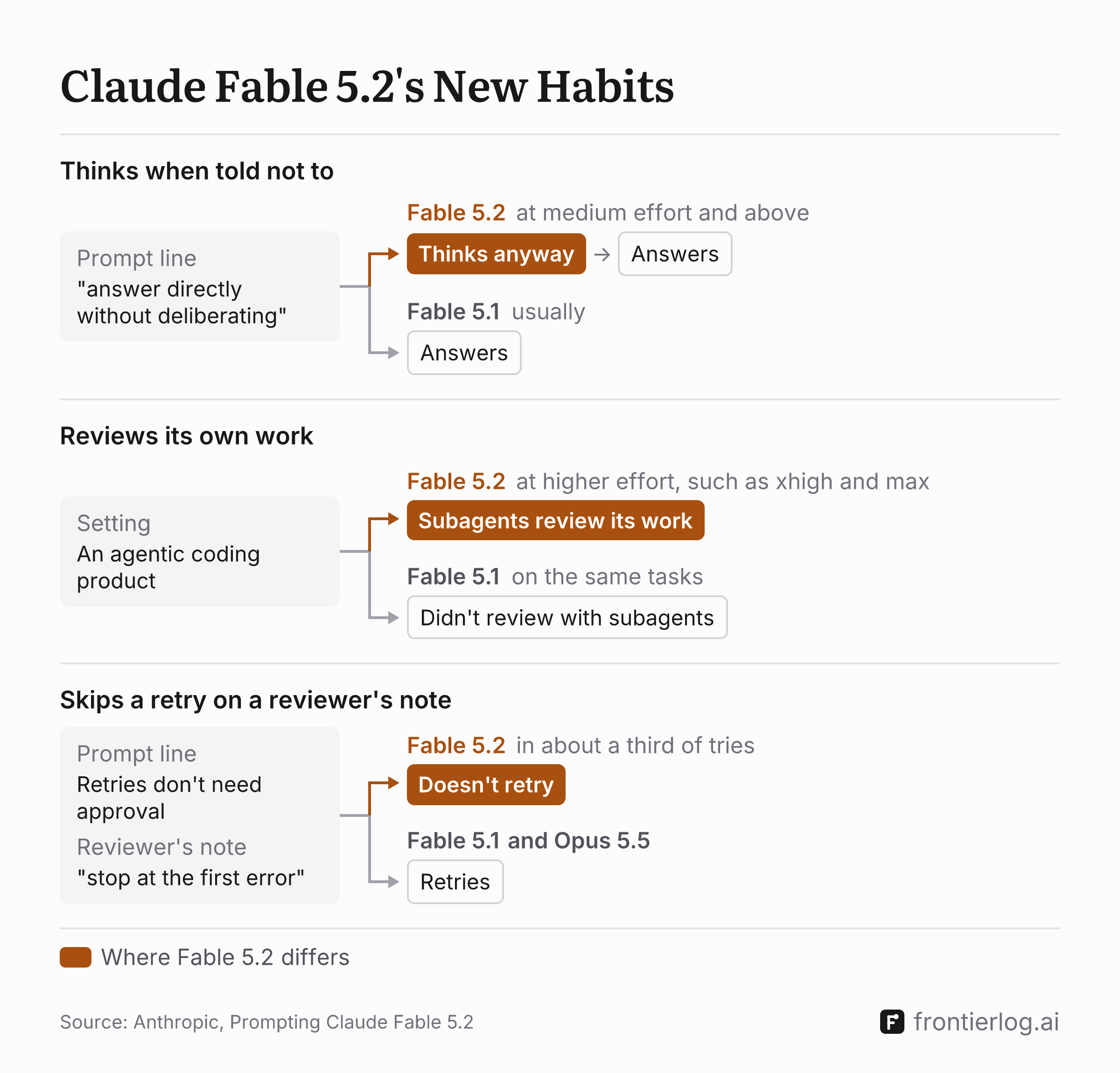
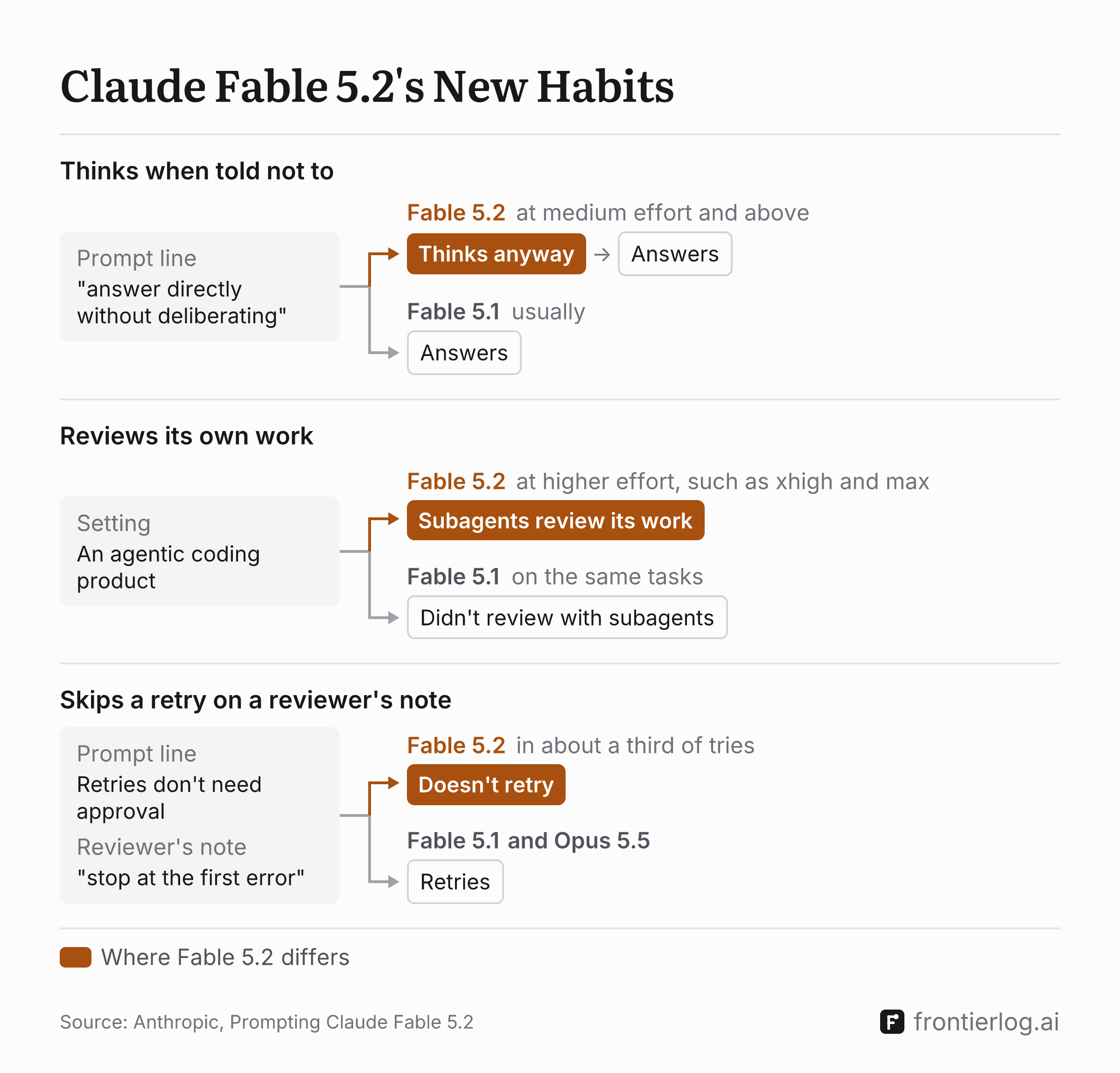
| Setup | Claude Fable 5.2 | Earlier models |
|---|---|---|
| Prompt line: "answer directly without deliberating" | Thinks anyway, at medium effort and above | Fable 5.1 usually follows it |
| An agentic coding product | Subagents review its work, at higher effort, such as xhigh and max | Fable 5.1 didn't, on the same tasks |
| Prompt line saying retries don't need approval, and a reviewer's "stop at the first error" | Didn't retry in about a third of tries | Fable 5.1 and Opus 5.5 retried |
Claude Fable 5.2 "behaves differently from earlier models in a few ways," Anthropic says in its guide to prompting the model and Claude Mythos 5.2. Anthropic launched the model on Nov 9. In three places, the guide compares Fable 5.2's behaviour directly with that of Claude Fable 5.1, and in one of them against Claude Opus 5.5 as well. For four of the changes it suggests, it also gives figures for what each one cost.
It thinks when told not to
At high effort and above, Fable 5.2 "thinks before almost every reply, including a reply to a greeting," the guide says. In Anthropic's testing, an instruction to answer directly without deliberating didn't stop it from thinking at medium effort and above. Fable 5.1 "usually follows a line such as 'answer directly without deliberating'," the guide adds. The effort level sets how much Fable 5.2 thinks, according to the guide. In Anthropic's testing, Fable 5.2's scores at low effort sat close to Fable 5.1's scores at higher effort levels.
It has subagents check its work
Anthropic observed Fable 5.2 using subagents to review its own work in an agentic coding product at higher effort levels, such as xhigh and max. "Claude Fable 5.1 didn't do this on the same tasks," the guide says. How often Fable 5.2 delegates depends on the harness: on short tasks with a minimal tool for starting subagents it rarely started one, and in an agentic coding product whose prompts invite delegation it delegated readily.
A reviewer's note can outweigh a retry rule
Fable 5.2 follows cautious instructions closely, Anthropic says. Earlier models follow them too, but "in one of the setups described here only Claude Fable 5.2 held back." In that setup, on simulated tasks, the prompt listed retries among the steps that don't need approval, and a reviewer's "stop at the first error" was in context. Fable 5.2 didn't retry in about a third of the tries. Fable 5.1 and Opus 5.5 retried, according to the guide.
What the fixes cost
The guide gives cost figures for four changes aimed at Fable 5.2's habits. In sessions Anthropic replayed at medium effort, text telling it to finish the whole task cut the sessions that ended with doable work left to about half, and output tokens rose by about 30 percent. The text removed most endings that ask permission or offer to continue, "but not endings that list what remains and then stop." A sentence starting "This codebase is yours" made it merge repeated code in about half of tries on small coding tasks, against under a tenth without it, at about 1.5 times the output tokens. With that sentence, it also made changes nobody had asked for, many of them new tests and documentation. Apart from bug fixes, it changed how an existing feature behaves in one try in six to ten, and more often at higher effort. Text asking for an opening line and a recap made it speak before its first tool call every time, and output tokens per task rose by roughly 20 percent. A reminder that the harness appends as a system message roughly halved its longest silent stretch, with no noticeable increase in tokens or time, the guide says. Fable 5.2's per-token prices are in our API price story.
| Change | What changed | Cost |
|---|---|---|
| "Finish the whole task" text | About half as many sessions ended with doable work left | Output tokens rose by about 30 percent |
| Sentence starting "This codebase is yours" | Merged repeated code in about half of tries, under a tenth without | About 1.5 times the output tokens |
| Opening line and recap text | Spoke before its first tool call every time | Output tokens rose by roughly 20 percent |
| Harness reminder after silent steps | Roughly halved the longest silent stretch | No noticeable increase in tokens or time |
Sources
- Anthropic, developer documentationplatform.claude.com/docs/en/build-with-claude/prompt-engineering/prompting-claude-fable-5-2