OpenAI and Claude Proof Checks
Outside groups took up four AI math claims from 2026. The Riemann Hypothesis proof was certified in Lean in a day. No written proof has been checked.
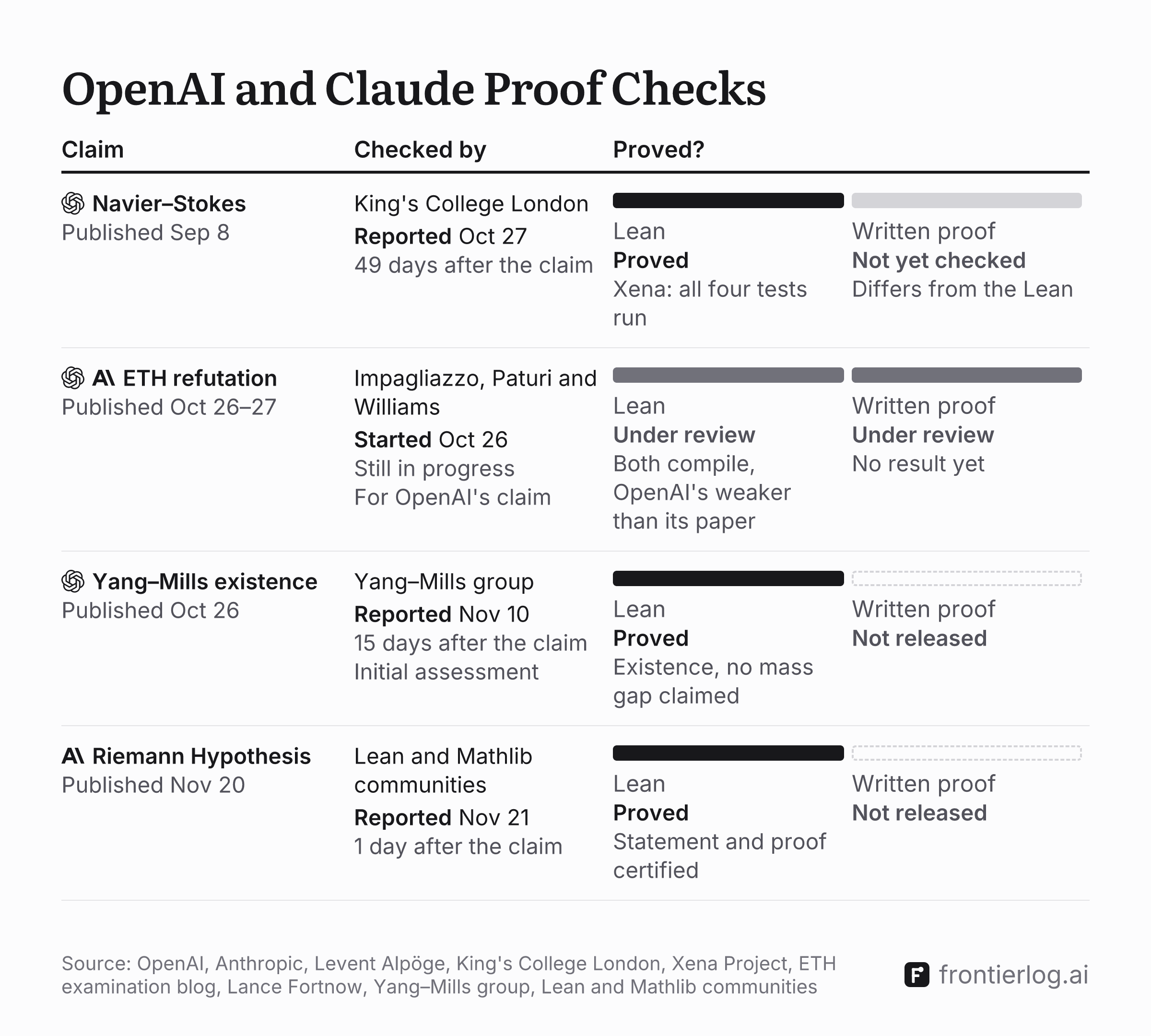
On Nov 21, the Lean and Mathlib communities certified the Lean proof of the Riemann Hypothesis that Anthropic's Levent Alpöge released the day before. Alpöge wrote in a Nov 20 note that he found the proof “working with Claude”. Outside groups also took up three of OpenAI's math claims since September. Two checks found a limit, and one review hasn't reported a result. The two reported checks of OpenAI's claims came 15 days after its post for Yang–Mills and 49 days after for Navier–Stokes.
| Claim | Checked by | Lean | Written proof |
|---|---|---|---|
| Navier–Stokes, Sep 8 | King's College London, reported Oct 27 | Proved, Xena: all four tests run (post) | Not yet checked: differs from the Lean |
| ETH refutation by OpenAI and Anthropic, Oct 26 and 27 | Impagliazzo, Paturi and Williams, started Oct 26, for OpenAI's claim | Under review: both compile, OpenAI's weaker than its paper (Fortnow) | Under review: no result yet |
| Yang–Mills existence, Oct 26 | Yang–Mills group, reported Nov 10, initial assessment | Proved: existence, no mass gap claimed | Not released |
| Riemann Hypothesis, Nov 20 | Lean and Mathlib communities, reported Nov 21 | Proved: statement and proof certified | Not released |
What a Lean check covers
On Nov 12, Kevin Buzzard's Xena Project set out four questions to ask of AI-generated Lean code. Does the Lean statement match the theorem in the paper? Does the code compile? Does it prove that statement from the standard axioms alone? Does it exploit a bug in Lean's kernel? The post adds that “in many cases (such as the OpenAI theorem dump) these tests have not yet been systematically done”.
Navier–Stokes: the Lean and the paper differ
On Sep 8, OpenAI shared a solution to the Navier–Stokes Millennium Prize Problem with “both a writeup of the proof and a formalization in Lean”. It says the Lean formalization and verification took 17 hours with GPT‑6 Astra. On Oct 27, 49 days later, King's College London reported a preprint by its own and Cambridge mathematicians. It found that the Lean version “does not fully match the proof published for human mathematicians”.
In one example, the written proof makes a stronger claim than the Lean proof. The preprint hasn't been peer reviewed, and it doesn't show that OpenAI's proof is wrong. The Xena post says all four of its tests have been run on the Navier–Stokes work, and that the written proof and the Lean proof diverge in places.
ETH: a review with no result yet
On Oct 26, OpenAI said its system proved the ETH false and that Lean verified the result. Anthropic published its own refutation of the Exponential Time Hypothesis the next day. On the day of OpenAI's post, Russell Impagliazzo, Ramamohan Paturi and Ryan Williams opened a community examination. They wrote that “our involvement should not be taken as certification of the claim”.
Lance Fortnow wrote on Oct 28 that he hadn't verified the proof himself. He still judged it “safe to assume now that the exponential-time hypothesis is toast”. He pointed to simpler follow-up proofs by Ryan O'Donnell and Shiva Kintali, and noted that OpenAI's Lean proof gives “a slightly weaker bound” than its paper.
On Oct 30, Francis Zane posted on the examination blog that a few people had compiled the Lean proofs. Commenters on the blog posted reruns of both labs' Lean proofs, and noted that the step from each lab's machine model to the usual one sat outside both labs' Lean, and one later reported putting it in Lean. The examination was opened for OpenAI's claim, and Anthropic's hasn't been the subject of an announced review. The blog hadn't posted a verdict as of Nov 22.
Yang–Mills: existence, without a mass gap
On Oct 26, OpenAI said its models produced an existence proof for quantum chromodynamics that “also includes a proof of the existence of pure Yang–Mills theory”. It finished the Lean formalization on Oct 16. On Nov 10, 15 days after OpenAI's post, the Yang–Mills group published its validation of the Lean code OpenAI submitted on Oct 28. A clean rebuild, an axiom audit and a Comparator check passed.
The group says the code constructs a quantum field theory that meets the Wightman axioms as a scaling limit of four-dimensional lattice gauge theory. The report says the code doesn't prove a mass gap. It doesn't prove the infinite-volume limit unique either. OpenAI didn't claim a mass gap. The group calls its report an initial assessment and writes that “we do not claim to fully understand the proof yet”. It used OpenAI's Astra to help read the code, and it didn't draw on OpenAI's written manuscript.
Riemann Hypothesis: certified in a day
Alpöge's note links only to the Lean code, in 14 archive parts. He calls a full written document “huge” and “unreadable”. He says he intends to write the argument up properly. On Nov 21, 1 day after the claim, the Lean and Mathlib communities certified the 17 million lines. Their statement is endorsed by the Lean FRO and the Mathlib Initiative, and it says all four Xena criteria are met.
The proved theorem matches Mathlib's own statement of the Riemann Hypothesis, compared by two independent tools. The statement says several proof checkers, including Lean's official kernel, checked the exported proof.
MIT's Andrew Sutherland lists the checks, run with Claude Code. All 175,187 modules compile, and the proof uses only Lean's three standard axioms. His page says “GRH” there means Dirichlet L-functions only, and that some kernel runs on the export were still going at its Nov 22 update. A pass, it says, relies on the checkers and on Mathlib's definitions being what they are meant to be.
Anthropic hasn't posted about the proof on its news or research pages as of Nov 22. AI Math Discoveries in 2026 lists each lab's math claims this year.
Timeline
- OpenAI shares a solution to the Navier–Stokes Millennium Prize Problem with a Lean proofOpenAI, research post
- OpenAI says its models proved the existence of pure Yang–Mills theory, formalized in LeanOpenAI, research post
- OpenAI says its system proved the Exponential Time Hypothesis false, verified in LeanOpenAI, research post
- Impagliazzo, Paturi and Williams open a community examination of OpenAI's ETH refutationRussell Impagliazzo, Ramamohan Paturi and Ryan Williams, blog post
- King's College London reports a preprint finding that OpenAI's Navier–Stokes Lean and written proof differ in placesKing's College London, news story
- Anthropic publishes its own refutation of the Exponential Time HypothesisAnthropic, paper on Hexagon
- Yang–Mills group validates OpenAI's Yang–Mills Lean code: the existence proof passes, no mass gap claimedYang–Mills group, validation report
- Xena Project sets four tests for AI-generated Lean, and says OpenAI's theorem dump is not yet systematically testedXena Project, blog post
- Levent Alpöge says he found a proof of the Riemann Hypothesis working with Claude, and releases it in LeanLevent Alpöge, note on his website
- Lean and Mathlib communities certify Alpöge's Lean code after independent checkers ran on it: statement and proof certified, 1 day after its releaseLean and Mathlib communities, joint statement
Sources
- OpenAI, research post, Sep 8, 2026On the Navier–Stokes Millennium Prize Problem
- OpenAI, research post, Oct 26, 2026Working with academic communities to build scientific understanding
- Levent Alpöge, note on his website, Nov 20, 2026alpo.ge/remark.pdf
- King's College London, news story, Oct 27, 2026kcl.ac.uk/news/openais-navier-stokes-proof-called-into-question
- Yang–Mills group, validation report, Nov 10, 2026raw.githubusercontent.com/yang-mills-group/YM/main/docs/assessment-1.pdf
- Xena Project, blog post, Nov 12, 2026xenaproject.wordpress.com/2026/11/12/and-the-proof-is-checked-in-lean
- Lean and Mathlib communities, joint statement, Nov 21, 2026leanprover-community.github.io/blog/posts/riemann-hypothesis
- Andrew Sutherland (MIT), verification page, Nov 22, 2026math.mit.edu/~drew/grh
- Russell Impagliazzo, Ramamohan Paturi and Ryan Williams, blog post, Oct 26, 2026ethdiscussion.blog/2026/10/26/eth-refutation-examination-and-discussion
- Francis Zane, blog post, Oct 30, 2026ethdiscussion.blog/2026/10/30/lean-replications
- Lance Fortnow, blog post, Oct 28, 2026blog.computationalcomplexity.org/2026/10/the-exponential-time-refutation.html
- Anthropic, paper on Hexagon, Oct 27, 2026hexagonmath.org/2610.00577v1