AI Math Discoveries in 2026
Four AI companies made 11 announcements on open math problems this year. Nine credit a model the public could not use that day.
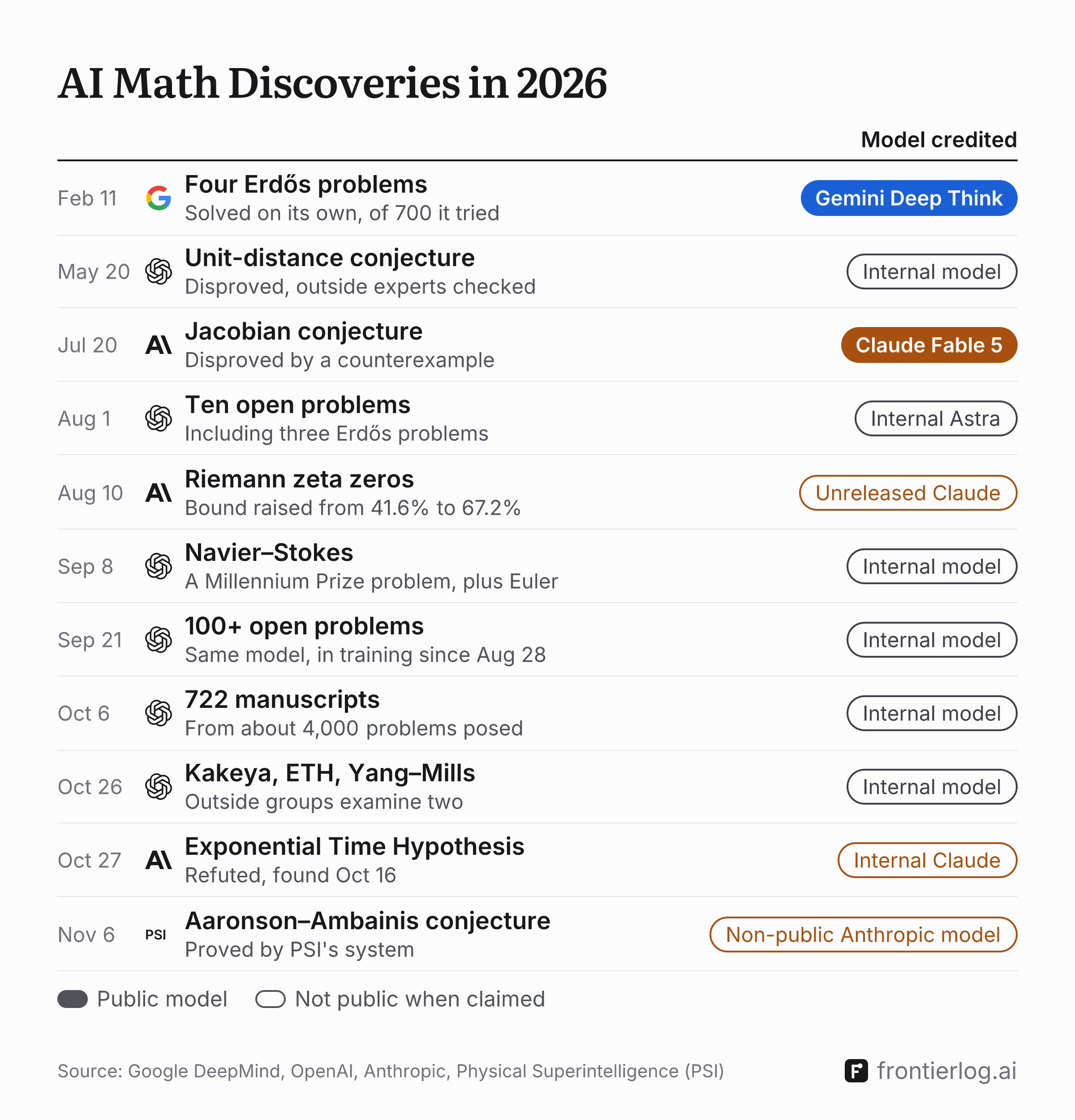
OpenAI, Anthropic, Google and the startup Physical Superintelligence (PSI) each announced results on open math problems in their own posts this year. Of the 11 announcements since Feb 11, nine credit a model that had no public release that day. The latest came on Nov 6, when PSI said its system proved the Aaronson–Ambainis conjecture using “instances of a non-public Anthropic model”.
Two claims credit a public model
On Feb 11, Google DeepMind wrote about Aletheia, a research agent powered by Gemini Deep Think. Google described a “semi-autonomous evaluation” of 700 open Erdős problems that included “autonomous solutions to four open questions”. Deep Think has been a mode in the Gemini app since Aug 1, 2025. Google upgraded it the next day, Feb 12. Google said it claims no “Major Advance” among these results.
On Jul 20, Anthropic’s Levent Alpöge posted a counterexample on X. He wrote that “the jacobian conjecture is false” and credited “fable”. Anthropic’s Jul 28 research post links to that post. It says “we announced that Claude Fable 5 resolved the Jacobian Conjecture”. Claude Fable 5 was public then. Anthropic made it available again to users globally on Jul 1, after suspending access for all users in June.
OpenAI’s claims all credit internal models
OpenAI made six announcements. On May 20 it said an internal model disproved Erdős’s unit-distance conjecture, and that outside mathematicians checked the proof. On Aug 1 it shared ten results on long-standing open problems, including Erdős problems 146, 180 and 183, from “an internal version of Astra, our next major model”. Each came with a Lean certificate. GPT-6 Astra launched on Sep 3.
On Sep 8, OpenAI shared a solution to the Navier–Stokes Millennium Prize Problem with a Lean proof. It came from “an internal model that is significantly more capable than GPT‑6 Astra”. The same post reports a disproof for the Euler equations with no external force. It also credits Anthropic’s Levent Alpöge and NYU’s Tristan Buckmaster with a resolution of the forced Euler problem “using an internal Anthropic model”, and recognizes “the priority of their work on forced Euler”. OpenAI began training its internal model on Aug 28. On Sep 21 it said the model “has now resolved more than 100 long-standing open problems”.
On Oct 6, OpenAI released a GitHub repository of results from an internal model. Its README counted 722 manuscripts in 372 families, from about 4,000 problems posed. The next day OpenAI withdrew three manuscripts after finding a sign error, and its history put the share of top-line results formalized in Lean at 300 of 719. On Oct 26 it announced three more results. OpenAI says its models proved the local smoothing conjecture, which resolves the Kakeya conjecture in all dimensions. It says its system proved the Exponential Time Hypothesis (ETH) false. It also says its models produced an existence proof for Yang–Mills theory and quantum chromodynamics. OpenAI says it formalized the Kakeya, ETH and Yang–Mills proofs in Lean. Outside groups will examine the ETH and physics results, and the physics group is holding back the AI output for now.
Anthropic’s internal Claude and PSI’s run
On Aug 10, Anthropic said “an unreleased research version of Claude” raised the lower bound for the share of Riemann zeta zeros on the critical line from 41.6% to 67.2%. Claude and an Anthropic staff member produced a Lean formalization. Two outside experts, Brian Conrey and Dan Goldston, examined the paper. On Oct 27, Anthropic published its own refutation of ETH, found on Oct 16 “by an internal Claude research model”, with a Lean proof. The ETH Refutation Timeline covers how the two labs’ ETH claims unfolded.
PSI’s Nov 6 post says its own system ran on PSI’s infrastructure, and that Lean accepted its first complete proof and the final version after two improvements. The Lean files are on GitHub. Stanford’s Guy Blanc, Jordan Docter, Carmen Strassle and Li-Yang Tan are reading the proof. PSI does not name the Anthropic model. Anthropic has published no post on the result as of Nov 9.
| Date | Party | Problem | Model credited | Public model |
|---|---|---|---|---|
| Feb 11 | Four Erdős problems | Gemini Deep Think | Yes | |
| May 20 | OpenAI | Unit-distance conjecture | Internal model | No |
| Jul 20 | Anthropic | Jacobian conjecture | Claude Fable 5 | Yes |
| Aug 1 | OpenAI | Ten open problems | Internal version of Astra | No, launched Sep 3 |
| Aug 10 | Anthropic | Riemann zeta zeros | Unreleased Claude | No |
| Sep 8 | OpenAI | Navier–Stokes | Internal model | No |
| Sep 21 | OpenAI | 100+ open problems | Internal model | No |
| Oct 6 | OpenAI | 722 manuscripts | Internal model | No |
| Oct 26 | OpenAI | Kakeya, ETH, Yang–Mills | Internal model | No |
| Oct 27 | Anthropic | Exponential Time Hypothesis | Internal Claude | No |
| Nov 6 | PSI | Aaronson–Ambainis conjecture | Non-public Anthropic model | No |
Timeline
- Google says its Aletheia agent, powered by Gemini Deep Think, solved four open Erdős problems on its ownGoogle DeepMind, blog post
- OpenAI says an internal model disproved Erdős's unit-distance conjectureOpenAI, research post
- Anthropic's Levent Alpöge posts that the Jacobian conjecture is false, crediting FableLevent Alpöge, X post
- OpenAI shares ten results on long-standing open problems from an internal version of AstraOpenAI, publication post
- Anthropic says an unreleased Claude raised the lower bound for Riemann zeta zeros on the line from 41.6% to 67.2%Anthropic, research post
- OpenAI shares a solution to the Navier–Stokes Millennium Prize Problem with a Lean proofOpenAI, research post
- OpenAI says the same model has resolved more than 100 long-standing open problemsOpenAI, company post
- OpenAI publishes 722 manuscripts from an internal model on GitHubOpenAI, research post
- OpenAI announces results on the Kakeya conjecture, the Exponential Time Hypothesis and Yang–Mills existenceOpenAI, research post
- Anthropic publishes a refutation of the Exponential Time Hypothesis by an internal Claude modelAnthropic, paper on Hexagon
- PSI says its research system proved the Aaronson–Ambainis conjecture using a non-public Anthropic modelPhysical Superintelligence, research post
Sources
- Google DeepMind, blog post, Feb 11, 2026Gemini Deep Think: Redefining the Future of Scientific Research
- OpenAI, research post, May 20, 2026An OpenAI model has disproved a central conjecture in discrete geometry
- Levent Alpöge, X post, Jul 20, 2026x.com/__alpoge__/status/2079028340955197566
- Anthropic, research post, Jul 28, 2026Discovering cryptographic weaknesses with Claude
- Anthropic, news post, Jun 30, 2026Redeploying Claude Fable 5
- OpenAI, publication post, Aug 1, 2026Ten advances in mathematics and theoretical computer science
- Anthropic, research post, Aug 10, 2026Claude has improved on a longstanding lower bound for the fraction of zeros of the Riemann zeta function that satisfy the Riemann hypothesis
- OpenAI, research post, Sep 8, 2026On the Navier–Stokes Millennium Prize Problem
- OpenAI, company post, Sep 21, 2026Advisory Group on Mathematics and Artificial Intelligence
- OpenAI, research post, Oct 6, 2026Sharing AI progress in mathematics
- OpenAI, GitHub README, Oct 6, 2026github.com/openai/math/blob/adc7f1241b42e322a6451854ab7e4b4c146bf78a/README.md
- OpenAI, GitHub release history, Oct 29, 2026github.com/openai/math/blob/4eaee87548250b2682affda7d05d947c05554bae/history.md
- OpenAI, research post, Oct 26, 2026Working with academic communities to build scientific understanding
- Anthropic, paper on Hexagon, Oct 27, 2026hexagonmath.org/2610.00577v1
- Anthropic, GitHub repository, Oct 27, 2026github.com/anthropics/formal-math/tree/16a5ce41304fcdaea4e0be7c132e1c361dc26da5/eth
- Physical Superintelligence, research post, Nov 6, 2026psi.inc/research/aaronson-ambainis
- Physical Superintelligence, GitHub repository, Nov 6, 2026github.com/physical-superintelligence/aaronson-ambainis