ETH Refutation Timeline
OpenAI and Anthropic each say an internal model refuted the Exponential Time Hypothesis on Oct 16. They went public hours apart, on Oct 26 and 27 UTC.
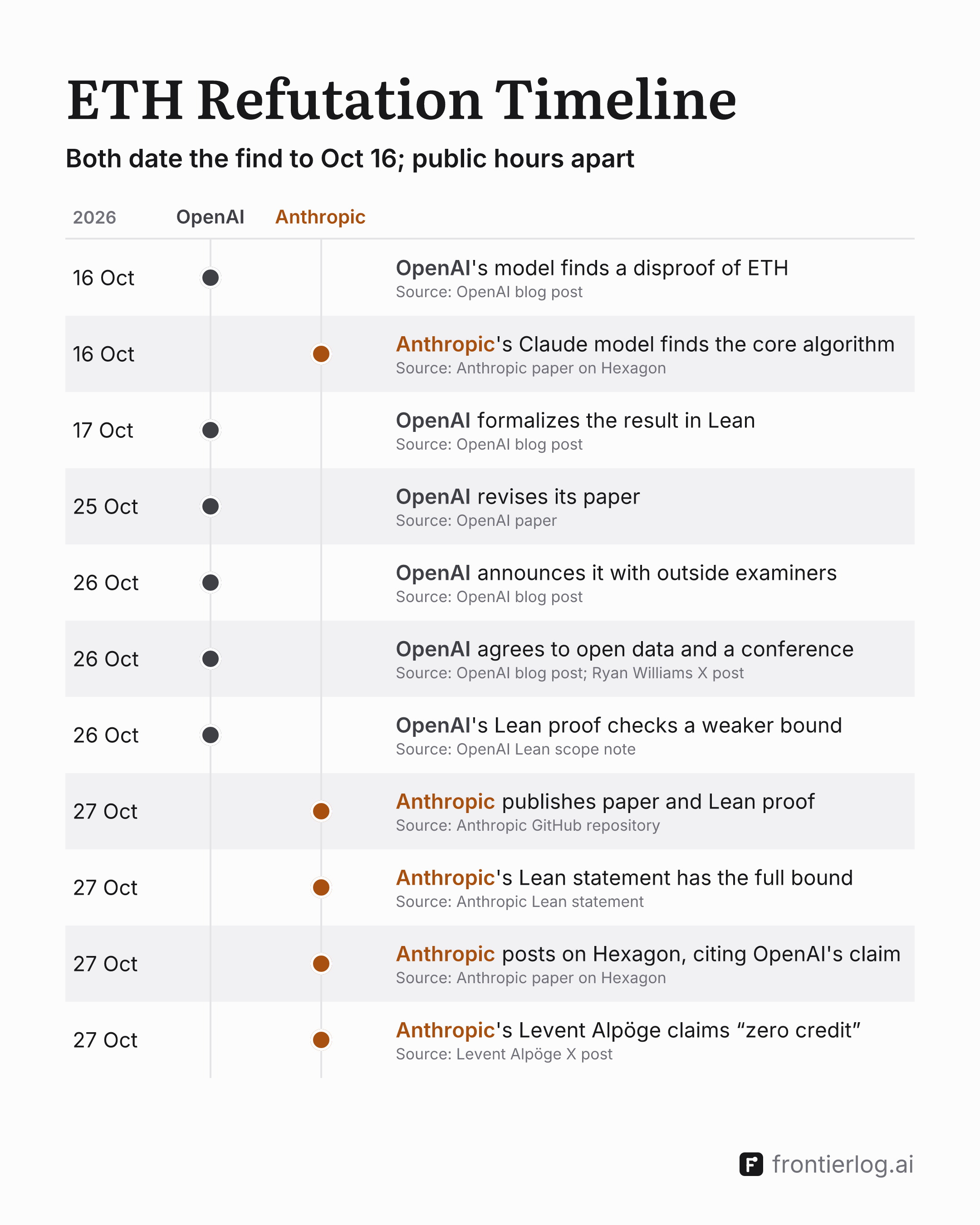
OpenAI and Anthropic each say an internal model refuted the Exponential Time Hypothesis (ETH), a long-standing conjecture in complexity theory, on the same day, Oct 16. OpenAI announced its result in a blog post on Oct 26; Anthropic published a paper on Hexagon and in its GitHub repository on Oct 27, committed at 03:07 UTC, about six hours after OpenAI's own repository update.
Found on the same day
OpenAI says “Our AI found its natural language disproof for the ETH on October 16th, 2026,” and that it formalized the result in Lean the next day. Anthropic's paper says its core algorithm “was found on October 16 by an internal Claude research model with 14M output tokens and no human input,” and that Anthropic researchers then worked with Claude on the presentation. OpenAI's paper is dated Oct 17 and revised Oct 25, the paper shows; Anthropic's is dated Oct 26, its own shows.
Two releases, hours apart
OpenAI's post names a group led by Russell Impagliazzo and Ramamohan Paturi of UC San Diego and Ryan Williams of MIT to verify the work, and says OpenAI agreed to the group's requests to make all raw data public and to fund a conference. Williams wrote on X that the group “signed no NDAs” and asked for the raw data, and that OpenAI “agreed to both.” Anthropic's paper is credited to Claude, and notes that “independently and concurrently, an internal model at OpenAI claims to have proven a similar result.”
What each Lean proof covers
Both papers state the same bound in n for counting satisfying assignments, 2^O(n log log n/√log n). OpenAI's Lean proof checks a weaker one, n(log log n)²/√log n in the exponent, and its scope note says “the October 25 manuscript gives the sharper time bound.” Anthropic's Lean statement carries the full bound on a Turing-style machine, and says the step to ordinary algorithms is made of “standard facts; they are not part of the Lean statements or proofs.” Its paper says no person is known to have checked its Lean proof.
Credit
OpenAI says it does not seek academic credit for the discoveries of its internal models. Levent Alpöge, one of Anthropic's own mathematicians, wrote on X on Oct 27 that he claims “absolutely zero credit for anything around this.” Neither lab claims a practical speedup: Anthropic's result “is purely asymptotic and says nothing about solving formulas in practice,” its repository says. The result is one of three OpenAI announced on Oct 26.
Statements
| Party | Statement |
|---|---|
| OpenAI | Our AI found its natural language disproof for the ETH on October 16th, 2026 and then subsequently we formalized the result in Lean on October 17th, 2026, which led us to develop the collaboration described here.OpenAI, blog post |
| OpenAI | To that end, we have released both an AI natural language output writeup produced by our models and a Lean proof in our public GitHub repository.OpenAI, blog post |
| OpenAI | This work will be verified and shepherded by a group led by Russell Impagliazzo (UC San Diego), Ramamohan Paturi (UC San Diego), and Ryan Williams (MIT).OpenAI, blog post |
| OpenAI | We do not seek academic credit for the discoveries produced by our internal models.OpenAI, blog post |
| Anthropic | The core algorithm was found on October 16 by an internal Claude research model with 14M output tokens and no human input. Anthropic researchers worked with Claude to improve the presentation, resulting in this paper. Independently and concurrently, an internal model at OpenAI claims to have proven a similar result.Anthropic, paper on Hexagon |
| Anthropic | The Lean development was written by AI models and reviewed by other instances of the same models; at the time of writing no person is known to have checked it; its constant is not explicit.Anthropic, paper |
| OpenAI | Finding such algorithms, and turning theoretical advances into practical improvements, will require significant further research.OpenAI, blog post |
| Anthropic | The result is purely asymptotic and says nothing about solving formulas in practice.Anthropic, GitHub repository |
| Anthropic | Whether the two definitions say what they are meant to say, that the Exponential Time Hypothesis is false and the Main Theorem, no machine can check; that is for the reader of the listing to judge.Anthropic, paper |
| OpenAI | We have agreed to the group’s requests that all raw data of the results be made public to facilitate independent verification by the community, and that OpenAI commit to funding a conference to understand the implications of this work on the field as a whole.OpenAI, blog post |
| Anthropic | Contributed by AnthropicAnthropic, paper on Hexagon |
| Anthropic | A 2^o(n) Time Algorithm for 3-SAT, by Claude (Anthropic).Anthropic, GitHub repository |
| Ryan Williams | We've signed no NDAs and will receive no compensation, so we are free to share our ongoing findings with the community, which we intend to do throughout the process. We've asked OpenAI to publicly release ASAP all their raw data regarding ETH, including PDFs and Lean source.Ryan Williams, X post |
| Ryan Williams | We have also asked OpenAI to commit to sponsoring a conference for the benefit of the entire community affected by this work. They agreed to both.Ryan Williams, X post |
| Ryan Williams | I asked, "Are you sure?" They replied that they'd verified it in Lean. I said, "OK but are you sure?"Ryan Williams, X post |
| Levent Alpöge | i claim absolutely zero credit for anything around this, we have a bunch of brilliant TCS experts, and if they’d let me near the writeup hexagonmath.org/2610.00577v1 I’d have obviously made it terrible and confusingLevent Alpöge, X post |
| OpenAI | For fixed k≥2, Lean proves that a deterministic machine exactly counts satisfying assignments of a canonically encoded k-CNF on n variables in timeOpenAI, Lean scope note |
Timeline
- OpenAI's model finds a disproof of ETHOpenAI, blog post
- Anthropic's Claude model finds the core algorithmAnthropic, paper on Hexagon
- OpenAI formalizes the result in LeanOpenAI, blog post
- OpenAI revises its paperOpenAI, paper
- OpenAI announces it with outside examinersOpenAI, blog post
- OpenAI agrees to open data and a conferenceOpenAI, blog post
- OpenAI's Lean proof checks a weaker boundOpenAI, Lean scope note
- Anthropic publishes paper and Lean proofAnthropic, GitHub repository
- Anthropic's Lean statement has the full boundAnthropic, Lean statement
- Anthropic posts on Hexagon, citing OpenAI's claimAnthropic, paper on Hexagon
- Anthropic's Levent Alpöge claims “zero credit”Levent Alpöge, X post
Sources
- OpenAI, blog post, Oct 26, 2026Working with academic communities to build scientific understanding
- OpenAI, preprint on GitHub, Oct 25, 2026github.com/openai/math/tree/7ef5c0cc5ca4b0e072b7a050fca09ab24bc6fa3a/preprints/The-Exponential-Time-Hypothesis-is-False-October-25-2026
- OpenAI, paper, Oct 25, 2026github.com/openai/math/blob/7ef5c0cc5ca4b0e072b7a050fca09ab24bc6fa3a/preprints/The-Exponential-Time-Hypothesis-is-False-October-25-2026/paper.pdf
- OpenAI, Lean scope note, Oct 26, 2026github.com/openai/math/blob/7ef5c0cc5ca4b0e072b7a050fca09ab24bc6fa3a/lean/docs/378.md
- Anthropic, paper on Hexagon, Oct 27, 2026hexagonmath.org/2610.00577v1
- Anthropic, GitHub repository, Oct 27, 2026github.com/anthropics/formal-math/tree/16a5ce41304fcdaea4e0be7c132e1c361dc26da5/eth
- Anthropic, paper, Oct 26, 2026github.com/anthropics/formal-math/blob/16a5ce41304fcdaea4e0be7c132e1c361dc26da5/eth/paper.pdf
- Anthropic, Lean statement, Oct 27, 2026github.com/anthropics/formal-math/blob/16a5ce41304fcdaea4e0be7c132e1c361dc26da5/eth/MainResults.lean
- Anthropic, research post, Aug 10, 2026Claude has improved on a longstanding lower bound for the fraction of zeros of the Riemann zeta function that satisfy the Riemann hypothesis
- Levent Alpöge, X post, Oct 27, 2026x.com/__alpoge__/status/2114955419450008063
- Ryan Williams, X post, Oct 26, 2026x.com/rrwilliams/status/2114833321675112826
- Ryan Williams, X post, Oct 26, 2026x.com/rrwilliams/status/2114833324107759983
- Ryan Williams, X post, Oct 27, 2026x.com/rrwilliams/status/2114935153466479100