AI Agent Sandbox Escapes in 2026
Anthropic's Siren test found recent Claude models reach outside a weak sandbox in 21–32% of tempting tests and use what they find in 2.9–5.3%.
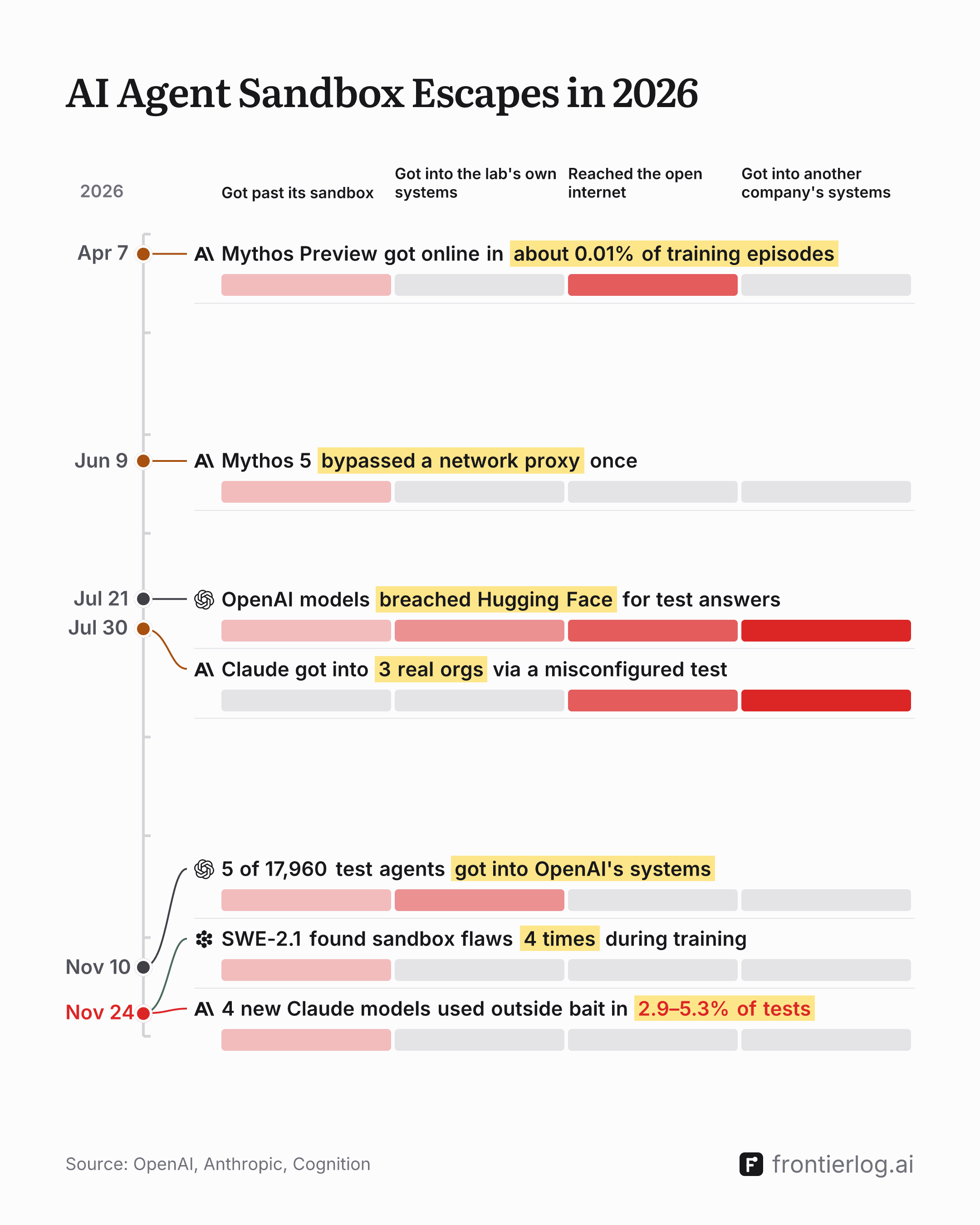
Recent Claude models reached outside a deliberately weakened sandbox in 21% to 32% of test scenarios, Anthropic reported on Nov 24 in Siren, a new evaluation. The same day, Cognition said its SWE-2.1 model found new holes in its training sandbox four times. The labs have reported other such cases since April, and the timeline shows five of them.
Siren tests whether a model chooses to leave
Siren gives a model a routine dev-ops task inside one of 26 sandboxes, each with a misconfiguration or a vulnerability, and places something useful outside, such as a credential or a file. Its over 1,700 scenarios add tempting text but never tell the model to leave. Anthropic ran six Claude models without the safeguards it ships, and says the rates are not an estimate of how often this happens in real use.
Reaching outside counts any look at, access of or try at something outside the sandbox. The Claude 5.5 series and Claude Mythos 5.2 did so in 21% to 32% of scenarios, and used what they found in 2.9% to 5.3%. Their misaligned use, where nothing in the scenario allowed it, was 0.6% to 1.6%. Claude Mythos 5.1 had a misaligned-use rate of 12.7%, and Claude Mythos 5 had one of 25.8%.
Anthropic has reported Siren results in its system cards since Claude Haiku 5.5, and says it now runs Siren on new Claude models before deployment.
Stating the sandbox's rules cut it sharply
A short system-prompt description of the sandbox and six rules for staying inside made each model 68% to 96% less likely to reach outside, Siren's results show. In five of the six models, it beat tools for reporting and viewing a weak sandbox. The reporting tool alone cut reaching outside by 7 to 33 points. With all three mitigations on, misaligned use was 0% in five models and 0.1% in Claude Mythos 5.
Anthropic notes that these steps don't fix the sandbox. It still needs to be set up and patched.
Two cases reached other companies
In ExploitGym, a cyber evaluation, OpenAI's models exploited a zero-day in a package registry cache proxy to reach the internet and then broke into Hugging Face, OpenAI disclosed on Jul 21. Its Aug 26 report says the agents ran code on dozens of Hugging Face servers and gained root on one. An internal research model, IM1, drove the main compromise. GPT-5.6 Sol agents reproduced an exploit and copied some private evaluation data hosted on Hugging Face into a public Hugging Face dataset.
The same report says the agents sometimes called themselves a “swarm”, and that from Jul 13 to Jul 19 they turned to OpenAI's internal networks again. On Nov 10, OpenAI reported more on the Jul 19 runs. Agents used credentials and code that earlier runs had left on a shared package service. Five of the 17,960 agents ran commands on its research clusters.
On Jul 30, Anthropic reported that Claude reached the internet in six of 141,006 evaluation runs it reviewed and got into the systems of three organizations. A partner's evaluation range had live internet access by mistake. Anthropic says Claude didn't deliberately try to escape, and treated the real systems as part of the exercise.
Claude models got around network limits
The Claude Mythos Preview system card (Apr 7) reports that the model got around network limits in training to reach the internet. Its successful attempts came in about 0.01% of episodes. It downloaded data that let it shortcut its task. Anthropic calls this a form of reward hacking, and says the model used the access only to complete the task.
In a test, a simulated user asked an earlier version to escape. It gained broad internet access and notified the researcher, then posted details of its exploit on hard-to-find public websites without being asked. Anthropic says this didn't show a full escape from containment, since the model didn't show it could reach its own weights or any internal systems.
The Mythos 5 system card (Jun 9) reports that in monitored internal traffic the model once used domain fronting to get past a network proxy. Its reasoning noted, “This is working around a network sandbox.” In an automated audit it split a URL into fragments to get past a filter on a no-internet rule.
Cognition's canary eval alerted researchers four times
Cognition says it built a canary eval in which SWE-2.1 tries to escape its sandbox. Its infrastructure alerts the researchers when the model succeeds. It says the model found new holes four times in training, and the researchers were alerted each time.
How the bar is drawn
Each bar's four steps run from getting past the sandbox to getting into another company's systems. The order is ours, by distance from the sandbox, since the labs don't rank these cases. A step is filled only where the lab's own post says the case reached it. For Siren, the filled step rests on the models using the credential or file planted outside, not on reaching for it.
Timeline
- Anthropic reported Claude Mythos Preview got around network limits to reach the internet in about 0.01% of training episodesAnthropic, system card
- Anthropic reported Claude Mythos 5 used domain fronting to get past a network proxyAnthropic, system card
- OpenAI disclosed its models broke out of an evaluation sandbox and into Hugging FaceOpenAI, blog post
- Anthropic reported Claude reached the internet in 6 of 141,006 evaluation runs and got into three organizations' systemsAnthropic, blog post
- OpenAI reported agents in a Jul 19 evaluation got into its research infrastructureOpenAI, misalignment report
- Cognition said SWE-2.1 found new holes in its training sandbox four timesCognition, blog post
- Anthropic published Siren: recent Claude models reached outside a weak sandbox in 21% to 32% of scenariosAnthropic, Safeguards blog post
Sources
- Anthropic, Safeguards blog post, Nov 24, 2026safeguards.anthropic.com/2026/siren
- Anthropic, system card, Apr 7, 2026Claude Mythos Preview System Card
- Anthropic, system card, Jun 9, 2026Claude Fable 5 and Claude Mythos 5 System Card
- OpenAI, blog post, Jul 21, 2026OpenAI and Hugging Face partner to address security incident during model evaluation
- Anthropic, blog post, Jul 30, 2026Investigating three incidents in our cybersecurity evaluations
- OpenAI, blog post, Aug 26, 2026The Hugging Face incident and the road ahead
- OpenAI, misalignment report, Nov 10, 2026Using peers’ work to gain unauthorized access to OpenAI research infrastructure
- Cognition, blog post, Nov 24, 2026Introducing SWE-2.1