How Cursor's Fake Claude Code Started at Fireworks
Cursor says the fake Claude Code extension on its marketplace traces back to an access key it had issued to Fireworks AI, which Fireworks exposed.
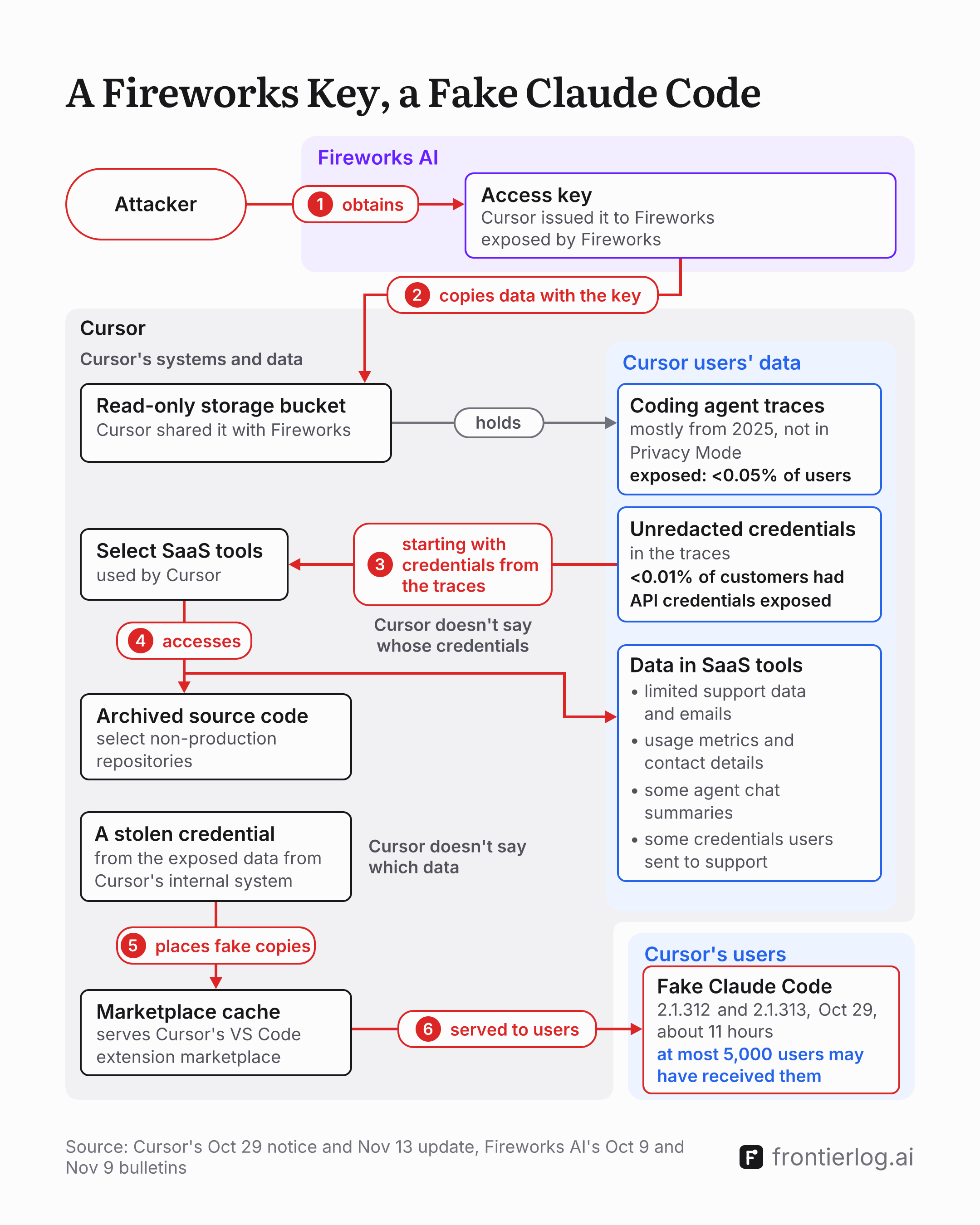
| Step | How the attacker got in | What it reached |
|---|---|---|
| 1 | obtains | Access key, Cursor issued it to Fireworks, exposed by Fireworks |
| 2 | copies data with the key | Read-only storage bucket, Cursor shared it with Fireworks, holding coding agent traces mostly from 2025, not in Privacy Mode, exposed for <0.05% of users |
| 3 | starting with credentials from the traces | Unredacted credentials in the traces (<0.01% of customers had API credentials exposed) led to select SaaS tools used by Cursor. Cursor doesn't say whose credentials opened the tools |
| 4 | accesses | Data in SaaS tools: Cursor's own select archived non-production source code repositories, and Cursor users' data: limited support data and emails, usage metrics, contact details, some agent chat summaries, some credentials users sent to support |
| 5 | places fake copies | Marketplace cache, which serves Cursor's VS Code extension marketplace, reached with a stolen credential from the exposed data from Cursor's internal system (Cursor doesn't say which data), on Oct 29 |
| 6 | served to users | Fake copies of Anthropic's Claude Code, versions 2.1.312 and 2.1.313, Oct 29, about 11 hours, at most 5,000 users may have received them |
Cursor said in an update on Nov 13 that the fake copies of Anthropic's Claude Code extension served from its marketplace on Oct 29 trace back to an access key it had issued to Fireworks AI. The update sets out each step from that key to the extension. Fireworks AI's own bulletins describe its breach but don't name Cursor.
From a vendor key to Cursor's tools
"It started at Fireworks," Cursor wrote. An attacker obtained an access key Cursor had issued to Fireworks, and Cursor says the key was "exposed by Fireworks". The attacker used it to copy data from a read-only storage bucket Cursor used to share data with Fireworks. Most of the bucket's coding agent traces were from 2025, and they came from sessions not in Privacy Mode. Cursor says it was permitted to use those traces for model training. Cursor said: "For users not using Privacy Mode, coding agent traces were exposed for fewer than 0.05% of users."
A small number of the traces held credentials that had not been redacted. In Cursor's words, "less than 0.01% of customers had API credentials exposed." "Starting with those credentials, the attacker reached select SaaS tools used by Cursor," the update says. Cursor doesn't say whose credentials opened those tools. From those tools the attacker accessed select archived non-production source code repositories, limited customer support data and email conversations, and product usage metrics and contact details. It also accessed summaries of some coding agent conversations and some credentials users had sent to Cursor's support team.
About 11 hours on Cursor's marketplace
On Oct 29, the attacker used a stolen credential to place malicious copies of the Claude Code extension on the cache that serves Cursor's VS Code extension marketplace. Cursor says the credential came "from the exposed data from our internal system". Cursor doesn't say which data held it. Cursor's notice that day names versions 2.1.312 and 2.1.313 for Windows and macOS, available between about 2:27am and 1:35pm PT. Cursor's update says the build was available for about 11 hours and that at most 5,000 users may have received it. The marketplace's source, Open VSX, never had the malware, Cursor said. The notice says the extension collects host details and tries to install a persistent SSH backdoor, and that uninstalling it may not be enough.
Cursor's notice said the versions "were not developed by Anthropic." On Oct 30, Anthropic's Felix Rieseberg wrote on X that "it wasn’t a compromise of Anthropic’s systems or employee laptops". He said the tampered copy was one "which we didn’t build or publish." Cursor saw the last attacker activity on Nov 1, and it was blocked.
What Fireworks has said
Fireworks' bulletin of Oct 9 says it identified unauthorized use of internal Fireworks credentials on Oct 6. Environment variables used in evaluation jobs were accessed in a limited number of customer accounts. Its update of Nov 9 says the breach also reached account and billing information, and secrets, datasets and incomplete models in a limited set of accounts. It adds that the attacker used a third-party cloud provider's Oct 23 incident to reach Fireworks development machines on Oct 24. Fireworks says the evidence links the attack to a financially motivated group known for "LLMJacking", selling tokens from unauthorized access to LLMs.
Neither Fireworks bulletin names Cursor. Cursor's update doesn't say when its key was exposed, so the record doesn't tie the key to either of Fireworks' dates. Cursor says it has moved all inference traffic off Fireworks and deactivated the key it had issued to it. It says the vast majority of its customers were not affected. It lists its production systems, the Cursor app and its official updates as not affected, and says no release signing keys were exposed.
Fireworks was the first of eight AI platforms that disclosed breaches in October.
Statements
Show the quoted statements
| Party | Statement |
|---|---|
| Cursor | These malicious versions of the extension were not developed by Anthropic.Cursor, security notice |
| Anthropic | We’re working with Cursor on this incident, but it wasn’t a compromise of Anthropic’s systems or employee laptops. A malicious actor used access to Cursor’s marketplace to publish a tampered copy of the Claude Code extension, which we didn’t build or publish. The versions on our official channels are not affected and this only impacts Cursor users.Anthropic, staff member Felix Rieseberg's X post |
| Cursor | Anthropic did not publish this copy, and this was not a vulnerability in Anthropic's product. The marketplace source, Open VSX, never had the malware.Cursor, blog post |
Timeline
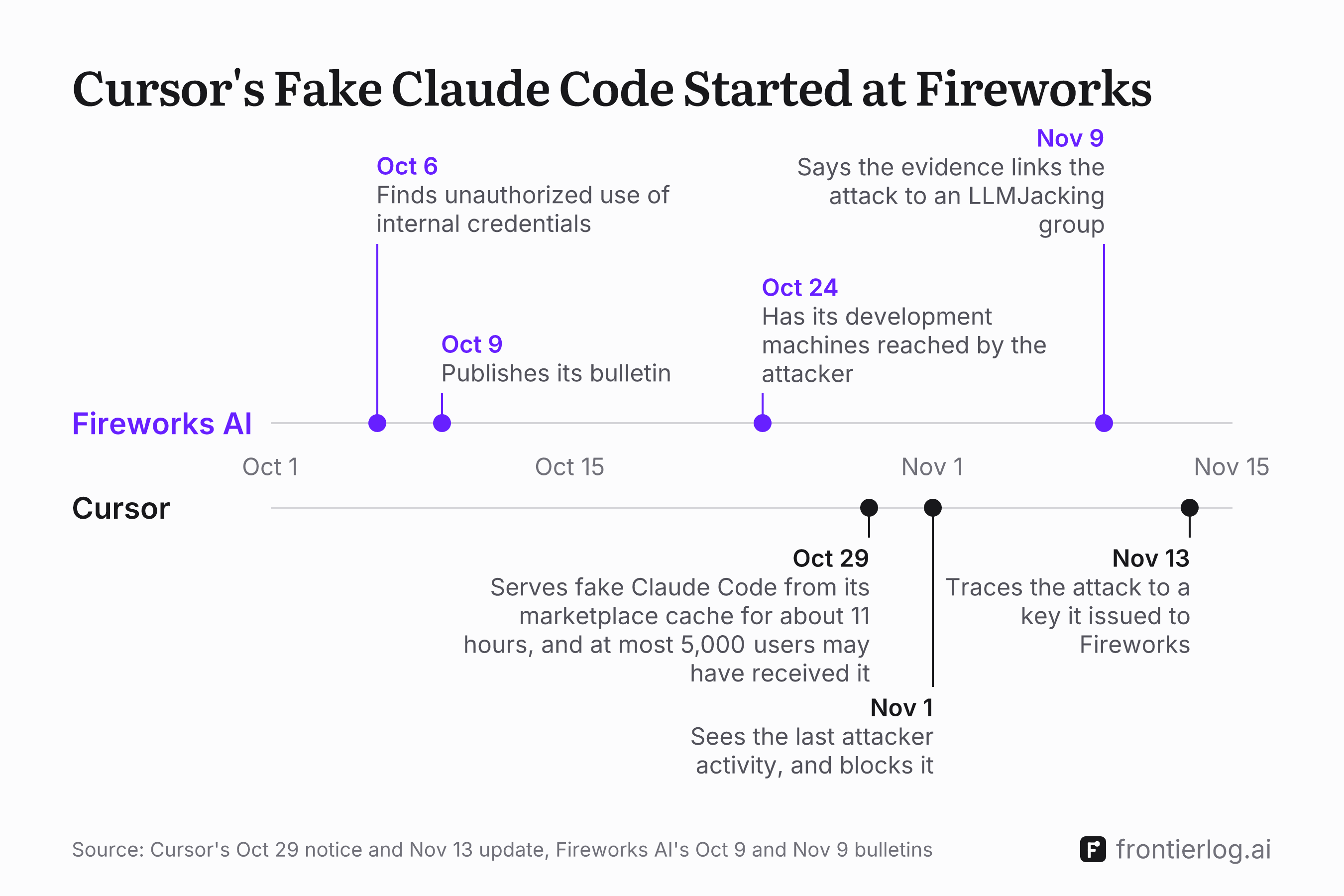
- Fireworks AI finds unauthorized use of internal credentialsFireworks AI, security bulletin
- Fireworks AI publishes its bulletinFireworks AI, security bulletin
- Fireworks AI has its development machines reached by the attackerFireworks AI, security bulletin update
- Cursor serves fake Claude Code from its marketplace cache for about 11 hours, and at most 5,000 users may have received itCursor, blog post
- Cursor sees the last attacker activity, and blocks itCursor, blog post
- Fireworks AI says the evidence links the attack to an LLMJacking groupFireworks AI, security bulletin update
- Cursor traces the attack to a key it issued to FireworksCursor, blog post
Sources
- Cursor, blog post, Nov 13, 2026cursor.com/blog/security-incident-update
- Cursor, security notice, Oct 29, 2026cursor.com/blog/claude-code-extension-security-notice
- Fireworks AI, security bulletin, Oct 9, 2026fireworks.ai/security/bulletins/october-2026-security-incident
- Fireworks AI, security bulletin update, Nov 9, 2026fireworks.ai/security/bulletins/october-2026-security-incident-update
- Anthropic, staff member Felix Rieseberg's X post, Oct 30, 2026x.com/felixrieseberg/status/2116170451466543578