Claude Sets Effort and Thinking Separately
Anthropic's docs make effort and thinking two separate settings for Claude, while other labs' docs tie effort to how much a model thinks.
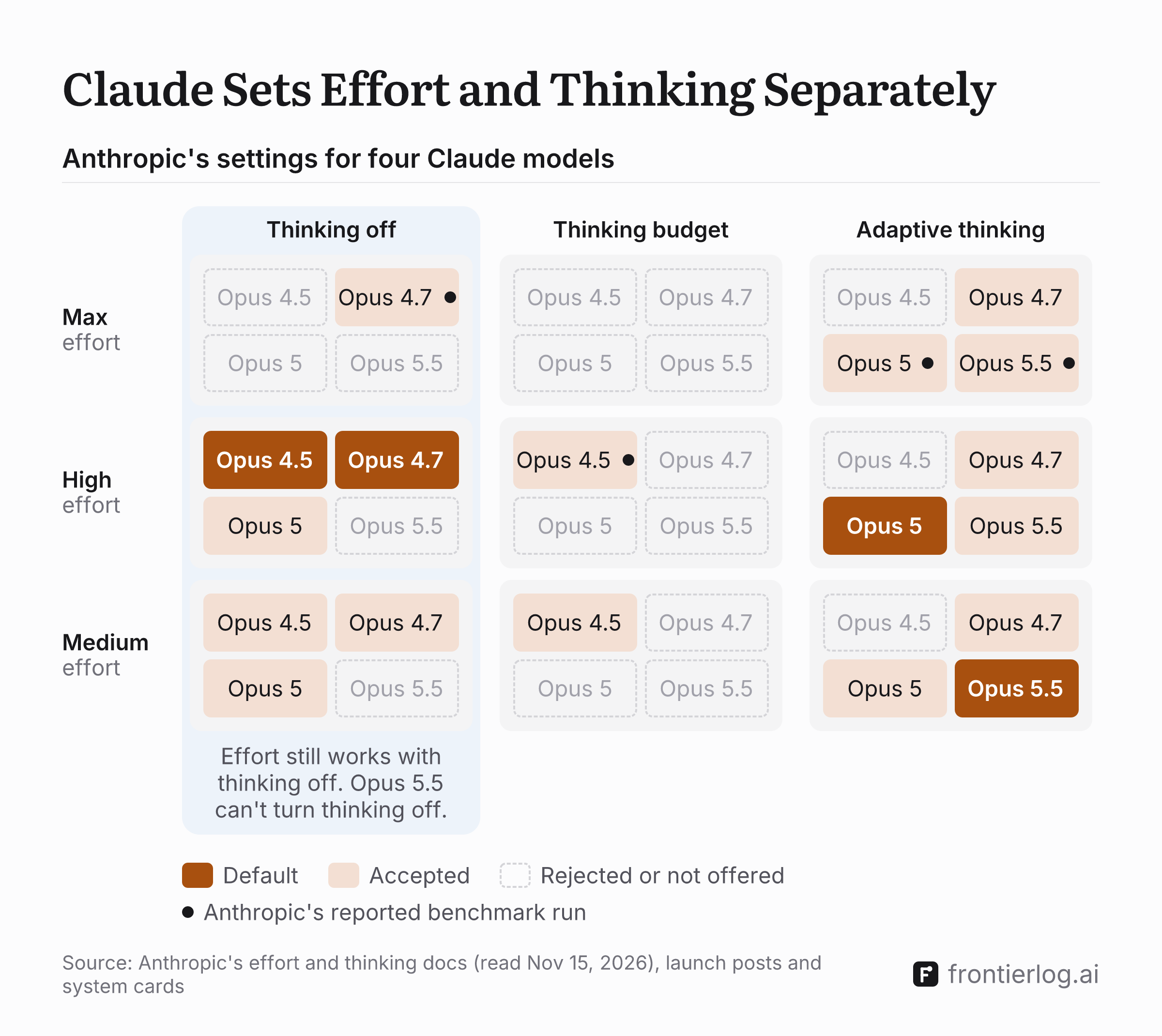
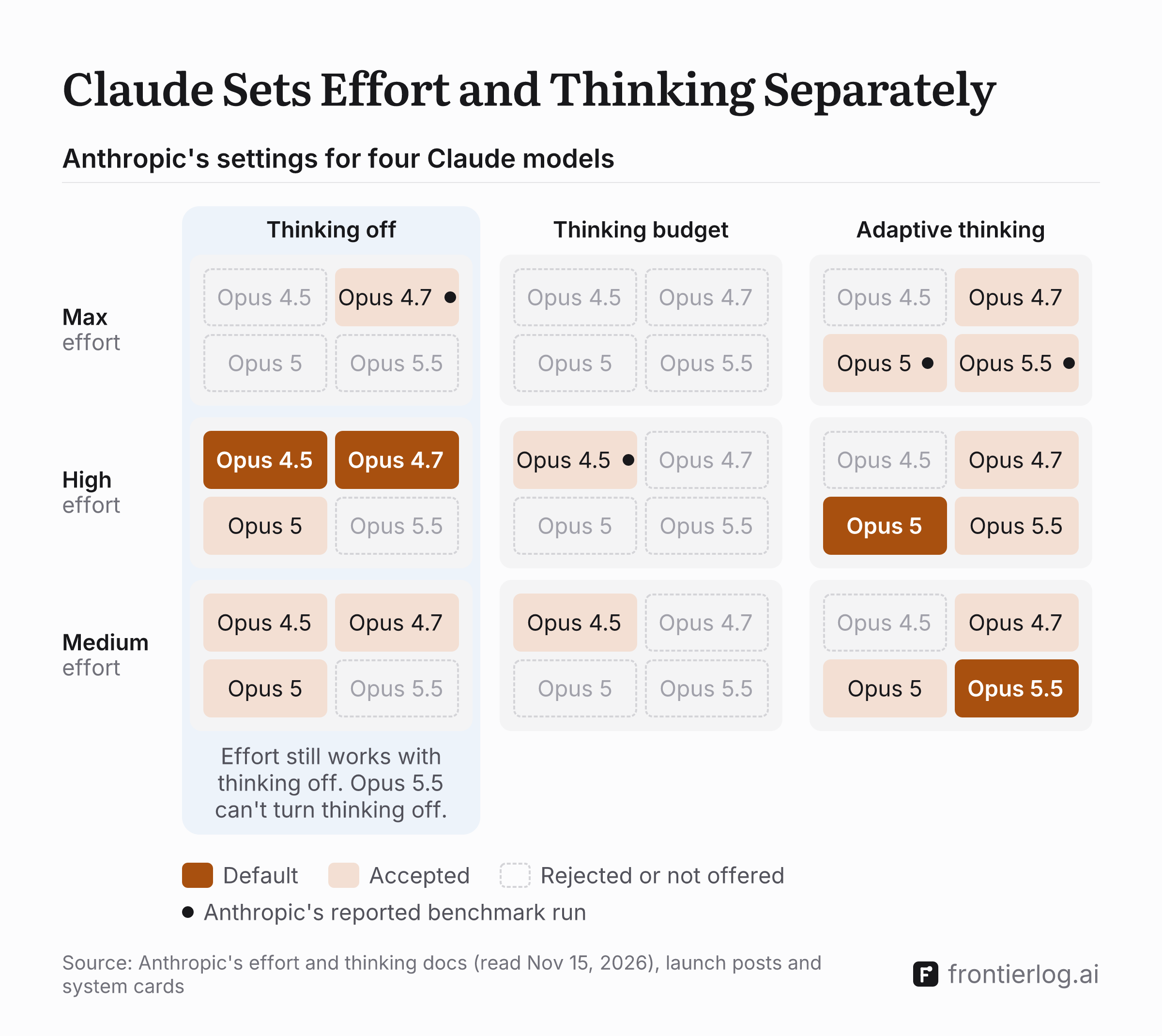
Anthropic gives developers two settings for how much Claude reasons. Thinking decides whether Claude thinks before it answers. Effort sets how much work Claude puts into the whole reply. In Anthropic's thinking docs, effort "controls how much work Claude puts into the whole response, which in adaptive mode includes how often and how deeply it thinks." Other labs' API docs describe a single effort or thinking level, or a thinking switch with an effort setting tied to thinking.
On Opus 5.5 and the Fable models, thinking always stays on and effort is the setting left to change. Sonnet 5.5 and Haiku 5.5 still turn thinking off up to high effort. The docs' tables show which pairings of the two each model accepts.
Effort arrived beside a thinking budget
Anthropic added effort with Claude Opus 4.5 on Nov 24, 2025. That model sets thinking with a token budget. Thinking stays off unless a request turns it on. The Opus 4.6 post on Feb 5 added adaptive thinking, where Claude decides when to think. "Previously, developers only had a binary choice between enabling or disabling extended thinking," it said. The same post added a fourth effort level, max.
Claude Opus 4.7 added a fifth level, xhigh, on Apr 16. The troubleshooting docs say that Claude 4.7 and later models reject a thinking budget. Opus 4.7 and Opus 4.8 still start with thinking off.
Thinking off narrowed on newer models
Claude Opus 5 thinks by default. It accepts thinking off only at high effort or below, and the docs say a request that turns thinking off at xhigh or max returns an error. Claude Haiku 5.5 follows the same rule. Claude Sonnet 5.5 uses a new setting, `between_tools`, to turn off up-front thinking. It also works only up to high effort.
On the Fable models and Claude Opus 5.5, thinking can't be turned off. The effort docs say of Opus 5.5: "Adaptive thinking is always on and can’t be turned off, so effort is the primary control for how much the model reasons and what a request costs." Opus 5.5 also defaults to medium effort, where earlier Opus models default to high.
| Model | Thinking off | Thinking budget | Adaptive thinking | Effort levels | Default effort |
|---|---|---|---|---|---|
| Claude Opus 4.5 | Default | Accepted | Rejected | Low, medium, high | High |
| Claude Opus 4.6 | Default | Deprecated | Accepted | Low, medium, high, max | High |
| Claude Sonnet 4.6 | Default | Deprecated | Accepted | Low, medium, high, max | High |
| Claude Opus 4.7 | Default | Rejected | Accepted | Low, medium, high, xhigh, max | High |
| Claude Opus 4.8 | Default | Rejected | Accepted | Low, medium, high, xhigh, max | High |
| Claude Fable 5 | Rejected | Rejected | Always on | Low, medium, high, xhigh, max | High |
| Claude Sonnet 5 | Accepted | Rejected | Default | Low, medium, high, xhigh, max | High |
| Claude Opus 5 | Up to high effort | Rejected | Default | Low, medium, high, xhigh, max | High |
| Claude Fable 5.1 | Rejected | Rejected | Always on | Low, medium, high, xhigh, max | High |
| Claude Opus 5.5 | Rejected | Rejected | Always on | Low, medium, high, xhigh, max | Medium |
| Claude Sonnet 5.5 | Up to high effort, with `between_tools` | Rejected | Default | Low, medium, high, xhigh, max | High |
| Claude Haiku 5.5 | Up to high effort | Rejected | Default | Low, medium, high, xhigh, max | Medium |
| Claude Fable 5.2 | Rejected | Rejected | Always on | Low, medium, high, xhigh, max | High |
Other labs use one effort or thinking level
OpenAI, Google, xAI, Mistral, Moonshot AI and MiniMax don't pair a thinking switch with an effort level on any one model. Each model has at most one effort or thinking level for how much it reasons. OpenAI's lowest effort level, `none`, is for tasks that "do not benefit from any reasoning". GPT-5.6 and GPT-6 models also have a separate reasoning mode, standard or pro. xAI says of Grok 4.5 to 4.7: "Reasoning cannot be disabled."
DeepSeek, Alibaba and Z.ai pair a thinking switch with an effort setting. Their docs tie the effort to thinking. DeepSeek lists it under "Thinking Effort Control", and Z.ai says it "controls the degree of reasoning within the thought chain".
Anthropic's effort docs say effort reaches every output token: "Because effort applies to every output token, it works with or without thinking." On Opus 5.5 and the Fable models, thinking can't be turned off, so effort is the one setting left.
| Lab | Settings | What the docs say |
|---|---|---|
| Anthropic | Two separate settings | `effort` and `thinking` are separate parameters. "Because effort applies to every output token, it works with or without thinking." Thinking can't be turned off on Opus 5.5 and the Fable models. |
| OpenAI | One effort or thinking level | `reasoning.effort` runs from `none` to `max`. `none` is for tasks that "do not benefit from any reasoning", and GPT-6 Astra and GPT-6.1 Sol don't accept it. GPT-5.6 and GPT-6 models add a separate reasoning mode, standard or pro. |
| One effort or thinking level | `thinking_level` runs from `minimal` to `xhigh`. Thinking is on by default on every listed model except Gemini 2.5 Flash-Lite. | |
| xAI | One effort or thinking level | `reasoning_effort` runs from `low` to `xhigh` on Grok 4.6 and 4.7, and Grok 4.5 treats `xhigh` as `high`. "Reasoning cannot be disabled." |
| Mistral | One effort or thinking level | `reasoning_effort` sets reasoning. At `none`, Mistral Small and Mistral Medium think minimally. |
| Moonshot AI | One effort or thinking level | Kimi K3.1 Pro always reasons. `reasoning_effort` takes `low`, `high` or `max`. |
| MiniMax | One effort level, or a thinking switch | MiniMax M3.1 Flash always thinks, and `reasoning_effort` sets its thinking depth. MiniMax M3 has a thinking switch only. |
| DeepSeek | Thinking switch and thinking effort | A thinking switch, plus `reasoning_effort` (`low`, `high`, `max`) under the heading "Thinking Effort Control". |
| Alibaba | Thinking switch and thinking effort | `enable_thinking` turns thinking on or off, and `thinking_budget` caps the tokens for the reasoning process. Qwen3.8 Omni adjusts thinking effort with `reasoning_effort`. |
| Z.ai | Thinking switch and thinking effort | `thinking` turns thinking on or off. `reasoning_effort` "controls the degree of reasoning within the thought chain". |
How Anthropic sets them in its benchmark runs
Anthropic states these settings in its benchmark notes. The Opus 4.5 post says its evaluations ran with "a 64K thinking budget" at "default effort (high)", except SWE-bench Verified ("no thinking budget") and Terminal Bench ("128K thinking budget"). The Opus 4.7 system card says the model "scored 79.3% with thinking off at max effort" on BrowseComp, and adds: "We found that adaptive thinking performed slightly worse on this benchmark for this model." In the Opus 4.8 system card, Anthropic reports a re-run of Opus 4.7 on BrowseComp at 79.8 with a new blocklist, context compaction at 200K tokens and adaptive thinking.
The Opus 5 system card and the Opus 5.5 post report their results with adaptive thinking at max effort unless they say otherwise.
Two kinds of Anthropic document don't always agree. The Opus 4.6 post's note on Humanity's Last Exam says that "Claude models run 'with tools'" ran with "adaptive thinking enabled", and its results include Opus 4.5 and Sonnet 4.5. Anthropic's thinking docs list both models as rejecting adaptive thinking.
Anthropic's benchmark runs on the sample models
| Model | Score | Sources |
|---|---|---|
| Claude Opus 4.5High effort, thinking budgetMethodology note under the benchmark table: “All evals were run with a 64K thinking budget, interleaved scratchpads, 200K context window, default effort (high), default sampling settings (temperature, top_p), and averaged over 5 independent trials.” | 87.0% | Announcementbenchmark table (image), row 'Graduate-level reasoning, GPQA Diamond', column 'Opus 4.5' |
| Claude Opus 4.7Max effort, thinking offClaude Opus 4.7 system card, section 8.8.2 BrowseComp: “Opus 4.7 scored 79.3% with thinking off at max effort and a 10M token limit.” | 79.3% | Announcementbenchmark table (image), row 'Agentic search, BrowseComp', column 'Opus 4.7' |
| Claude Opus 4.7Adaptive thinking, a re-run reported in the Opus 4.8 system cardClaude Opus 4.8 system card, note under the section 8.1 evaluation summary table: “Changes to the Opus 4.7 BrowseComp score are due to a new blocklist, context compaction at 200k tokens and using adaptive thinking.” | 79.8% | Claude Opus 4.8 System CardSection 8.1 evaluation summary table (page 194), row 'BrowseComp', column 'Claude Opus 4.7' |
| Claude Opus 5Max effort, adaptive thinkingClaude Opus 5 system card, Table 8.1.A note: “Unless otherwise noted, all Claude Opus 5 results use the following standard configuration: adaptive thinking at max effort” | 79.2% | Claude Opus 5 System CardSection 8.1 Evaluation summary, Table 8.1.A, row 'SWE-bench Pro', column 'Opus 5' |
| Claude Opus 5.5Max effort, adaptive thinkingNote under the benchmark table: “Unless otherwise noted, all Claude Opus 5.5 results use adaptive thinking at max effort.” | 89.0% | Announcementbenchmark table, row 'Visual chart recognition, Chartography', column 'Opus 5.5', 'with tools' |
Sources
- Anthropic, API documentationplatform.claude.com/docs/en/build-with-claude/effort
- Anthropic, API documentationplatform.claude.com/docs/en/build-with-claude/thinking
- Anthropic, API documentationplatform.claude.com/docs/en/build-with-claude/thinking-troubleshooting
- Anthropic, Nov 24, 2025Introducing Claude Opus 4.5
- Anthropic, Feb 5, 2026Claude Opus 4.6
- Anthropic, Apr 16, 2026Introducing Claude Opus 4.7
- Anthropic, Apr 16, 2026Claude Opus 4.7 System Card
- Anthropic, Jul 24, 2026Claude Opus 5 System Card
- Anthropic, Sep 22, 2026Introducing Claude Opus 5.5
- OpenAI, API documentationdevelopers.openai.com/api/docs/guides/reasoning
- Google, API documentationai.google.dev/gemini-api/docs/thinking
- xAI, API documentationdocs.x.ai/developers/model-capabilities/text/reasoning
- Mistral, API documentationdocs.mistral.ai/inference/conversations/reasoning
- Moonshot AI, API documentationplatform.kimi.ai/docs/guide/use-thinking-models
- MiniMax, API documentationplatform.minimax.io/docs/api-reference/text-openai-api
- DeepSeek, API documentationapi-docs.deepseek.com/guides/thinking_mode
- Alibaba, API documentationalibabacloud.com/help/en/model-studio/deep-thinking
- Z.ai, API documentationdocs.z.ai/guides/capabilities/thinking
- Anthropic, May 28, 2026Claude Opus 4.8 System Card
- Anthropic, Jul 24, 2026Introducing Claude Opus 5