How AI Labs Watermark Text
Google, Anthropic, OpenAI and xAI each draw the line differently on marking AI-written text: by app, by API, by region and by who may check for the mark.
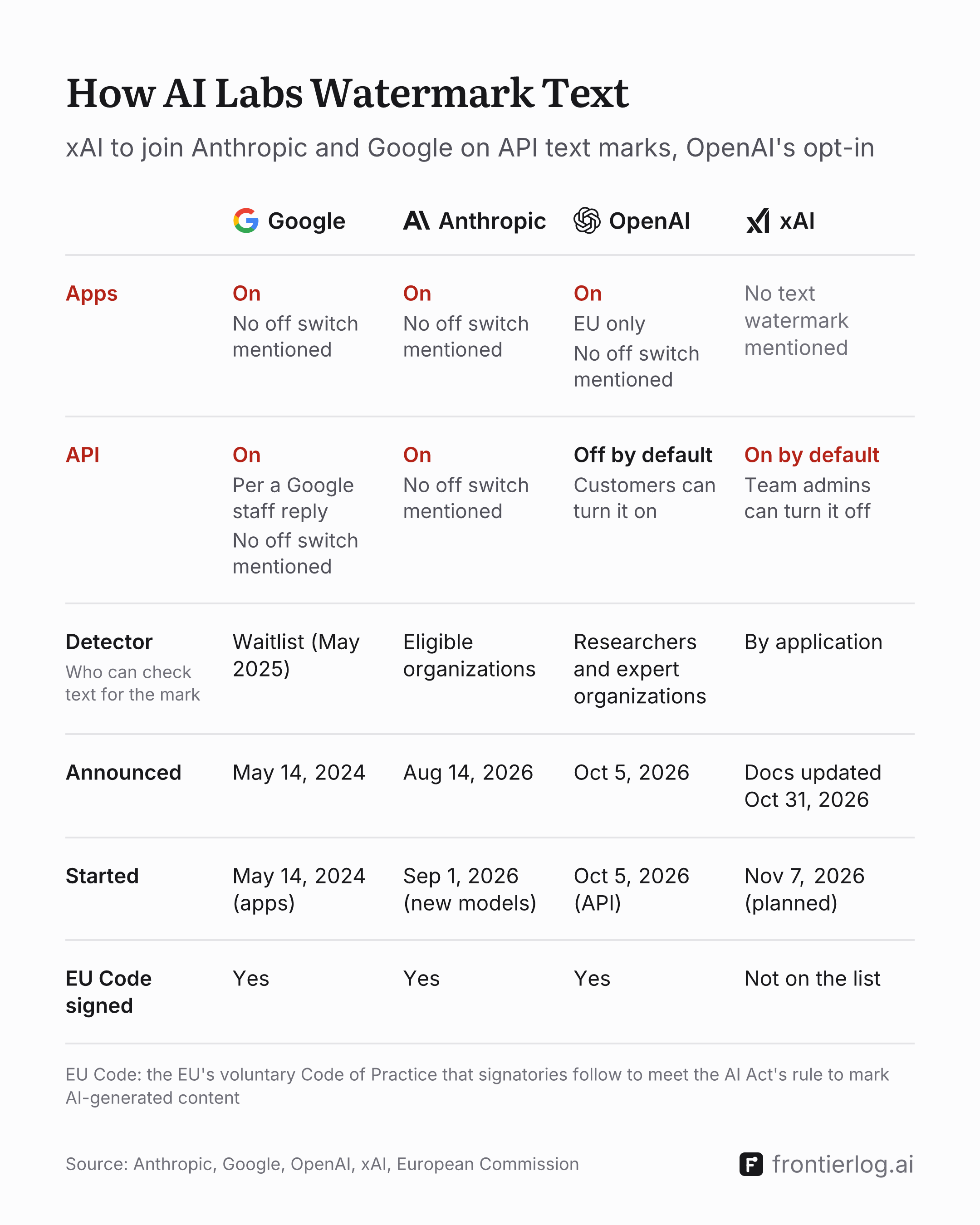
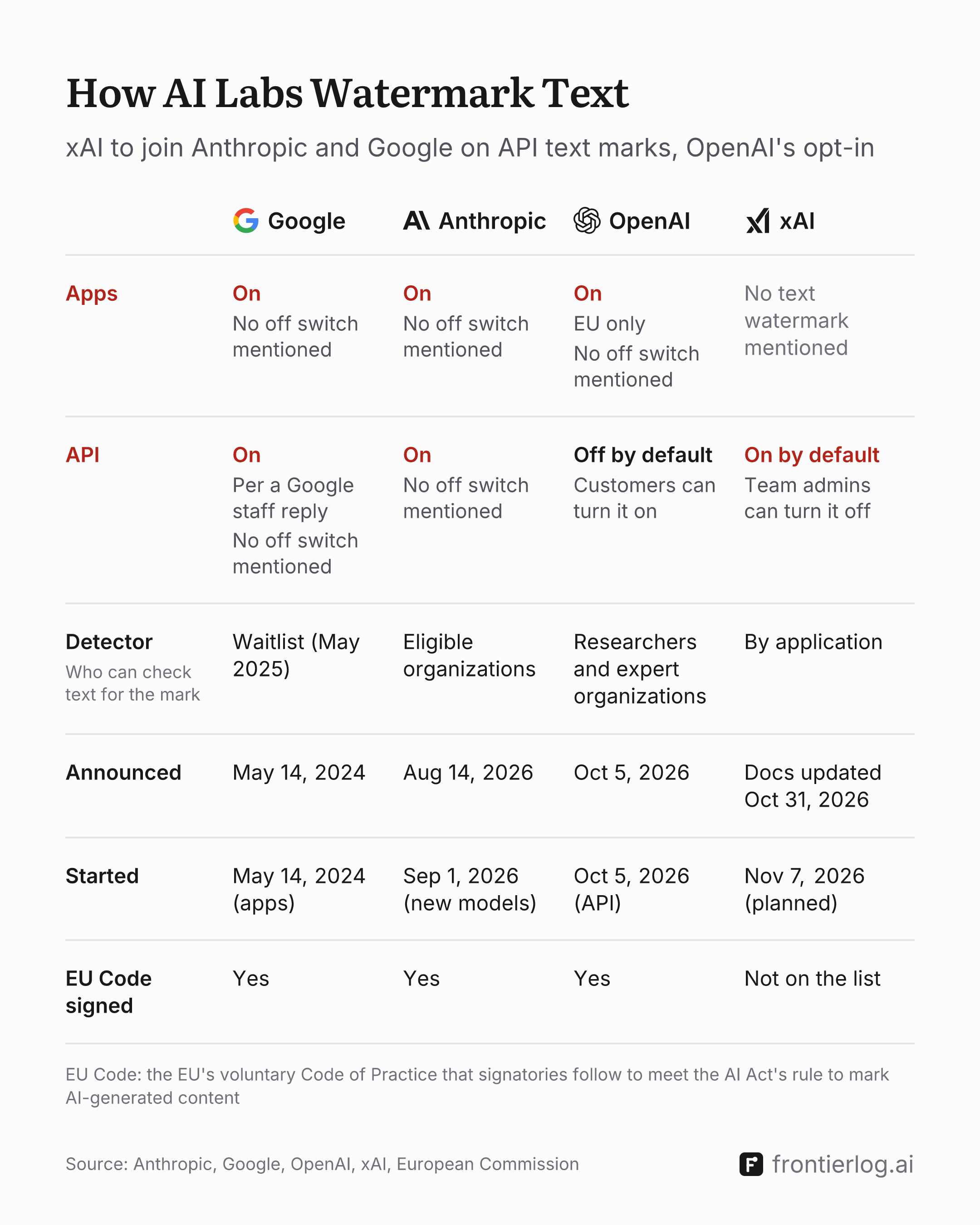
Google, Anthropic and OpenAI each watermark AI-written text, and xAI is about to start, each drawing the line in a different place. xAI's API documentation, published under the name SpaceXSI, says that from Nov 7, 2026, seven Grok models will mark their text by default on every API endpoint. OpenAI said on Oct 5 that its API stays off by default, and that it would mark ChatGPT and Codex text in the EU only.
The EU deadline behind it
The EU AI Act's Article 50 requires providers of generative AI to mark its output in a machine-readable way. The obligations apply from Aug 2, 2026, and AI systems placed on the market before that date have until Dec 2, 2026. About 190 organizations had signed the EU's Code of Practice on AI-generated content by the end of July, and the EU's list of signatories includes Anthropic, Google and OpenAI. xAI is not on it. Anthropic, OpenAI and xAI each say they watermark text to comply with the Act.
Anthropic marks everywhere, OpenAI in the EU
Anthropic said on Aug 14 that it applies watermarking globally "because we don't yet have a durable way to scope it by region." Its help center lists the surfaces: the API, the Claude apps, Claude Code, Claude Cowork, Claude Tag and the AWS, Google Cloud and Microsoft Foundry clouds. Models launched from Aug 2, 2026 are marked at launch: its post launching Claude Fable 5.1 and Mythos 5.1, which it released on Sep 1, says the Code "required us to add a watermark" to "the outputs of models released after August 2, 2026". Anthropic says it is adding marks to older models. On Nov 1 its table showed text marks on Claude Opus 4.8, Fable 5, Sonnet 5 and Opus 5, which launched before Aug 2, and none yet on models such as Claude Opus 4.7 and Sonnet 4.6.
OpenAI took the opposite approach. Its Oct 5 post says it is "not making text watermarking a global default at launch": it would add the mark to ChatGPT and Codex text in the EU "over the coming weeks", and API customers anywhere can turn it on for select models. Its help center lists text marking as "textGrain watermarks (EU only)" and says ChatGPT text in the EU now carries it.
xAI marks its API, with an opt-out
xAI's page names grok-4.7, grok-4.6, grok-4.5, grok-4.3 and three grok-4.20 models, and covers plain text, structured outputs and tool-call arguments. Team admins can turn the mark off per model after confirming "that an exception under applicable law applies to your use", and some models may be locked on. Neither this page nor xAI's consumer terms and FAQs mention a text watermark in the Grok apps. Its Grok FAQ says generated images and videos carry a Grok watermark.
Google's API, per its forum
Google's pages name the Gemini app and web for text watermarking, and its SynthID Detector post says SynthID covers text from its Gemini models "across Google". None of its documentation names the Gemini API. On Google's developer forum, a Google staff member wrote on Aug 19 that "text generated via the Gemini API IS actually SynthID-watermarked", and that the same applies to Google AI Studio and Antigravity. The reply corrected an Aug 5 reply that said API text was not watermarked. Later questions in the thread, on Vertex AI, on when API marking began and on how others can check API text, have no reply from Google.
Who can check
Each lab limits who can check text for its mark. xAI grants detection by application, and OpenAI to approved researchers and expert organizations. Anthropic opens its detection API to eligible organizations such as regulators, media and researchers, and to enterprises that must verify watermarks for their own compliance. Google opened its SynthID Detector, which takes text as well as images, audio and video, to early testers and a waitlist on May 20, 2025. Its SynthID page now says anyone can check an image, video or audio file with it, and names no wider access for text.
Statements
Show the quoted statements
| Party | Statement |
|---|---|
Today, we’re expanding SynthID’s capabilities to watermarking AI-generated text in the Gemini app and web experience, and video in Veo, our most capable generative video model.Google DeepMind, blog post | |
We are starting to roll this out to early testers today, before making it available more broadly. Journalists, media professionals and researchers can join our waitlist to gain access to the SynthID Detector.Google, blog post | |
After checking further with the team, it turns out that text generated via the Gemini API IS actually SynthID-watermarked! I apologize for the confusion earlier — the previous statement was incorrect. This also applies to text generated through Google AI Studio and/or antigravity!Google, staff reply on its developer forum | |
With the new SynthID Detector, anyone can easily check if an image, video, or audio file was made with AI from Google or our partners, including OpenAI, NVIDIA, Kakao, and soon, Apple.Google DeepMind, product page | |
| Anthropic | Marks will apply to output from supported Claude models across Claude Platform (API), Claude, Claude Code, Claude Cowork, and Claude Tag, and wherever Claude is offered, worldwide.Anthropic, help center article |
| Anthropic | Claude models launched in the EU on or after August 2, 2026 will support machine-readable marking at launch.Anthropic, help center article |
| Anthropic | We’re applying watermarking globally at launch because we don't yet have a durable way to scope it by region.Anthropic, blog post |
| Anthropic | Watermark detection is currently in private preview, available to eligible organizations as required under EU law (such as regulators, law enforcement, media, fact-checkers, independent researchers, educational organizations, and EU civil society groups).Anthropic, help center article |
| Anthropic | This required us to add a watermark—a numerical way of determining the likelihood that Claude was involved in writing a piece of text—to the outputs of models released after August 2, 2026.Anthropic, blog post |
| Anthropic | We’ve launched Claude Fable 5.1Anthropic, API release notes |
| OpenAI | Starting today, API customers globally will be able to opt in to text watermarking for select models. Text watermarking will remain off by default in the API.OpenAI, blog post |
| OpenAI | Over the coming weeks, we will introduce text watermarking to eligible ChatGPT and Codex users across all plans in the EU only. We are not making text watermarking a global default at launch.OpenAI, blog post |
| OpenAI | We’re opening applications to access our text watermark detector. Access will initially be limited to approved researchers and expert organizations that can help us evaluate and improve the technology.OpenAI, blog post |
| xAI | Starting November 7, 2026, responses from these models include a watermark. It's on by default, and you can opt out per model.xAI, API documentation |
| xAI | The watermark is enabled on every SpaceXSI API endpoint, including the global endpointxAI, API documentation |
| xAI | Opting out asks you to confirm that an exception under applicable law applies to your use, and that you are solely responsible for any marking, disclosure, or other legal requirement.xAI, API documentation |
| xAI | Access to watermark detection is granted by application.xAI, API documentation |
| xAI | Generated images and videos include a Grok watermark to indicate that the content was created with AI. There is no setting to remove the watermark.xAI, Grok FAQ |
| European Commission | There is an exception for AI systems placed on the market before that date. These AI systems benefit from a transitional period for compliance until 2 December 2026.European Commission, FAQ |
Timeline
- Google marks Gemini app and web text with SynthIDGoogle DeepMind, blog post
- Google opens the SynthID Detector to early testers and a waitlistGoogle, blog post
- The EU says about 190 organizations signed the Code of Practice by the end of JulyEuropean Commission, news article
- The EU's Article 50 marking obligations applyEuropean Commission, policy page
- Anthropic says Claude models will watermark text, globallyAnthropic, blog post
- Google staff say Gemini API text is SynthID-watermarked, correcting an Aug 5 replyGoogle, staff reply on its developer forum
- Anthropic launches Claude Fable 5.1 and Mythos 5.1, saying models released after Aug 2 carry the text watermarkAnthropic, blog post
- OpenAI opens opt-in API watermarking and plans EU-only marking in ChatGPT and CodexOpenAI, blog post
- xAI turns on watermarking by default for seven Grok API modelsxAI, API documentation
- The EU's transitional period ends for AI systems placed on the market before Aug 2European Commission, FAQ
Sources
- xAI, API documentation, Oct 31, 2026docs.x.ai/developers/advanced-api-usage/watermarking
- OpenAI, blog post, Oct 5, 2026Our approach to EU text provenance rules
- OpenAI, help center articlehelp.openai.com/en/articles/8912793
- Anthropic, blog post, Aug 14, 2026How Claude's text watermarking works
- Anthropic, help center articlesupport.claude.com/en/articles/16266773
- Google DeepMind, blog post, May 14, 2024Watermarking AI-generated text and video with SynthID
- Google, blog post, May 20, 2025SynthID Detector — a new portal to help identify AI-generated content
- European Commission, policy page, Oct 19, 2026digital-strategy.ec.europa.eu/en/policies/code-practice-ai-generated-content
- European Commission, news article, Jul 31, 2026digital-strategy.ec.europa.eu/en/news/strong-backing-code-practice-transparency-ai-generated-content
- European Commission, FAQ, Jun 10, 2026digital-strategy.ec.europa.eu/en/faqs/code-practice-transparency-ai-generated-content
- Google, staff reply on its developer forum, Aug 19, 2026discuss.ai.google.dev/t/does-gemini-api-text-output-carry-synthid-watermarking-gemini-2-5-flash-lite-gemini-3-1-flash-lite-eu-ai-act-art-50-2/177241/4
- Google, staff reply on its developer forum, Aug 5, 2026discuss.ai.google.dev/t/does-gemini-api-text-output-carry-synthid-watermarking-gemini-2-5-flash-lite-gemini-3-1-flash-lite-eu-ai-act-art-50-2/177241/2
- Google DeepMind, product pagedeepmind.google/models/synthid
- xAI, Grok FAQdocs.x.ai/grok/faq
- Anthropic, blog post, Sep 1, 2026Introducing Claude Fable 5.1 and Claude Mythos 5.1
- Anthropic, API release notesplatform.claude.com/docs/en/release-notes/overview
- a developer, question on Google's developer forum, Aug 19, 2026discuss.ai.google.dev/t/does-gemini-api-text-output-carry-synthid-watermarking-gemini-2-5-flash-lite-gemini-3-1-flash-lite-eu-ai-act-art-50-2/177241/5