How AI Labs Let Outside Assessors In
Anthropic said on Oct 15 that six METR staff have employee-like access. OpenAI signed four assessors on Nov 16 and says each gets what its work needs.
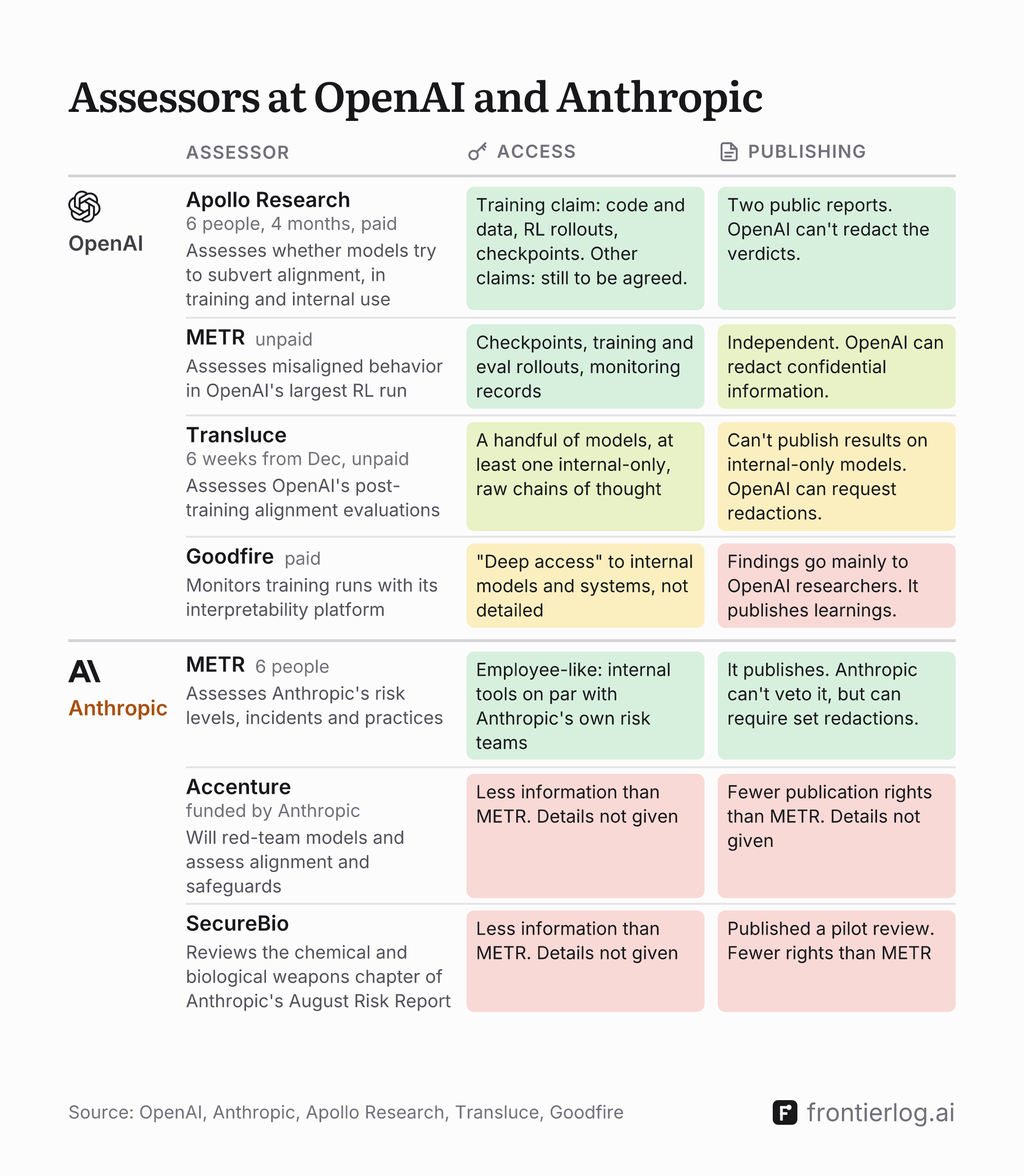
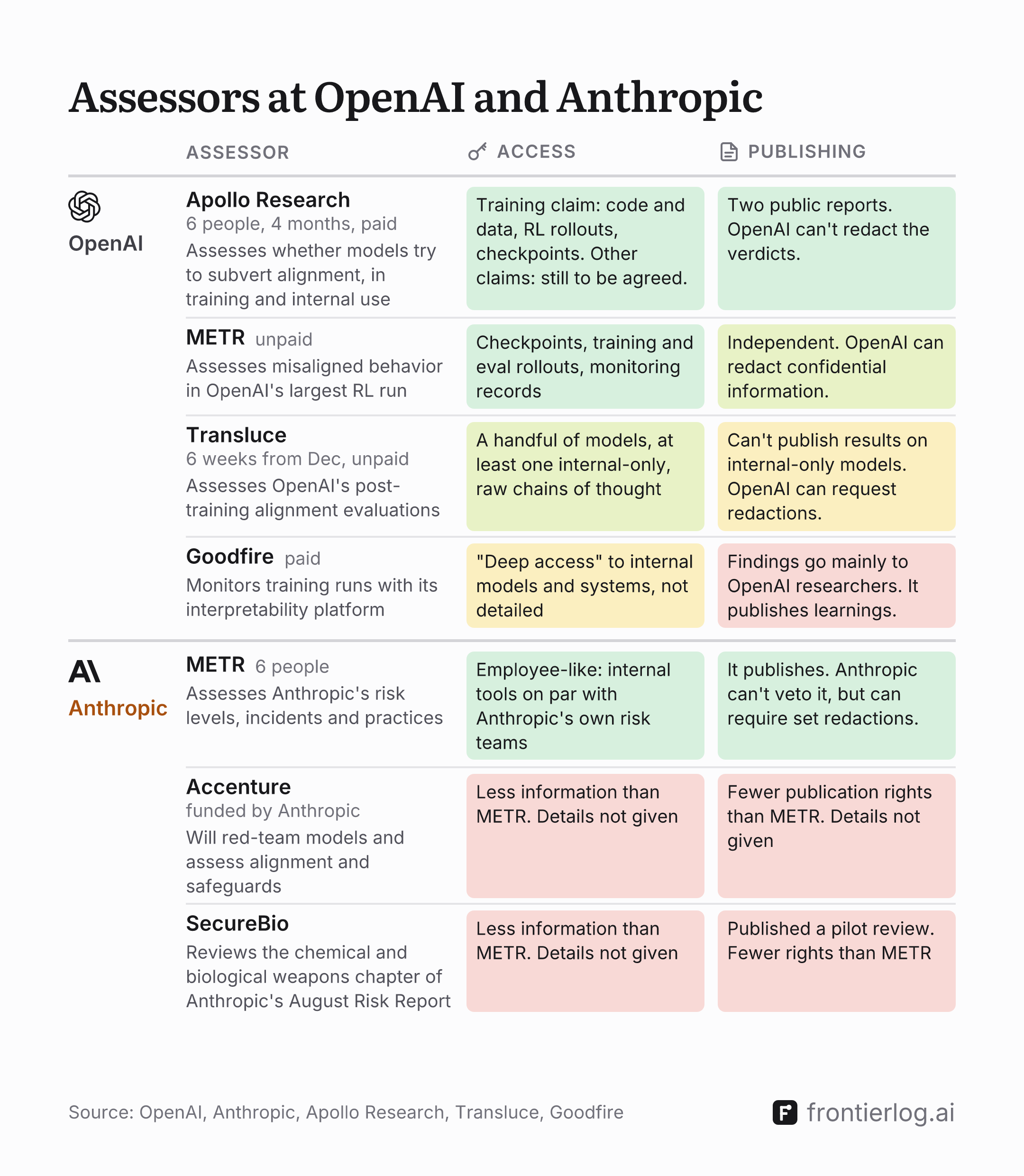
OpenAI signed agreements with four outside assessors on Nov 16: Apollo Research, METR, Transluce and Goodfire. Depending on what each assessment needs, the assessors get some of the same internal resources OpenAI's researchers use, “including model checkpoints, source code, training and evaluation data, monitoring systems”, the company said. A month earlier, on Oct 15, Anthropic said it had started giving a team from METR “employee-like access”.
| Assessor | What it assesses | Access | Publishing |
|---|---|---|---|
| Apollo Research at OpenAI | Whether models try to subvert alignment, in training and internal use | For its training claim: training code and data, RL rollouts, model checkpoints. Other access still to be agreed | Two public reports. OpenAI can't redact the verdicts |
| METR at OpenAI | Misaligned behavior in OpenAI's largest RL run | Checkpoints, training and eval rollouts, monitoring records | Independent. OpenAI can redact confidential information |
| Transluce at OpenAI | OpenAI's post-training alignment evaluations | A handful of models, at least one internal-only, raw chains of thought. Not employee-like, Transluce says | Can't publish results on internal-only models. OpenAI can request redactions |
| Goodfire at OpenAI | Training runs, with its interpretability platform | Deep access to internal models and systems, not detailed | Findings go mainly to OpenAI researchers. It publishes learnings |
| METR at Anthropic | Anthropic's risk levels, incidents and practices | Employee-like: internal tools on par with Anthropic's risk teams | It publishes. Anthropic can't veto it, but can require set redactions |
| Accenture at Anthropic | Red-teaming models, alignment and safeguards, in the works | Less information than METR. Details not given | Fewer publication rights than METR. Details not given |
| SecureBio at Anthropic | The chemical and biological weapons chapter of Anthropic's August Risk Report | Less information than METR. Details not given | Published a pilot review. Fewer rights than METR |
Four assessors at OpenAI
Apollo Research is sending a team of six to work within OpenAI for four months, Apollo said. The team will assess whether models try to subvert their own or their successors' alignment or control, across training, evaluations and internal use. To assess training, it gets training code and datasets, reinforcement learning rollouts and the ability to query intermediate model checkpoints. Access for its other claims is still to be agreed, and OpenAI may withhold some information within the agreed scope. OpenAI has agreed not to withhold information simply because it is unfavorable. Apollo will publish two reports. OpenAI may ask to redact evidence, but it may not redact Apollo's verdict on each claim.
METR will assess misaligned behavior in what OpenAI calls “our largest reinforcement learning run to date”. Its access includes checkpoints, training and evaluation rollouts and misalignment monitoring records for that run. OpenAI says this scope is narrower than the one METR proposed.
Transluce's pilot runs for six weeks from early December, Transluce said. Its staff will work on site to review OpenAI's post-training alignment evaluations. They get a handful of models, at least one of them internal-only, and can read raw chains of thought. Transluce says this access “is not comparable to ‘employee-level’ or ‘employee-like’ access”. The agreement bars Transluce from publishing results on internal-only models, and OpenAI can ask it to redact intellectual property and other non-public information. OpenAI says the two plan a second assessment of about eight weeks in early 2027.
Goodfire's researchers will use its interpretability platform to monitor OpenAI's training runs, Goodfire said. Its findings go mainly to OpenAI researchers, and it will publish what it learns as the work goes on.
OpenAI's protocols cover all four. Assessors who need sensitive information work on site, on OpenAI devices. A committee of the OpenAI Foundation's board reads the unredacted reports. OpenAI can still redact confidential information, and it may ask assessors to delay publishing findings that could pose security or safety risks. Apollo and Goodfire are paid for their work, OpenAI said. METR and Transluce don't accept payment, but they may accept API credits or compute for their assessments.
Three evaluators at Anthropic
Anthropic onboarded six METR employees with company hardware, office space and internal tools “roughly on par with what our own risk assessment teams have access to”, it said on Oct 15. METR will publish its analysis of Anthropic's risk levels, incidents or practices. Anthropic can't veto that, but it can require redactions in categories set in advance, and Anthropic decides what falls into them. METR can still make certain statements about the level of access and information it received.
Anthropic is developing three tiers of access for evaluators, and it calls METR's arrangement the third tier. Its other two evaluators, SecureBio and Accenture, get “more limited information” and “more limited publication rights”. Anthropic is also in early talks with other organizations, and Hugging Face is one of them. SecureBio is reviewing the chemical and biological weapons chapter of Anthropic's August Risk Report. On Sep 18, Anthropic said Faculty, Accenture's specialist AI business, would lead the Accenture work, and Anthropic will fund it directly.
From three-week pilots to months inside
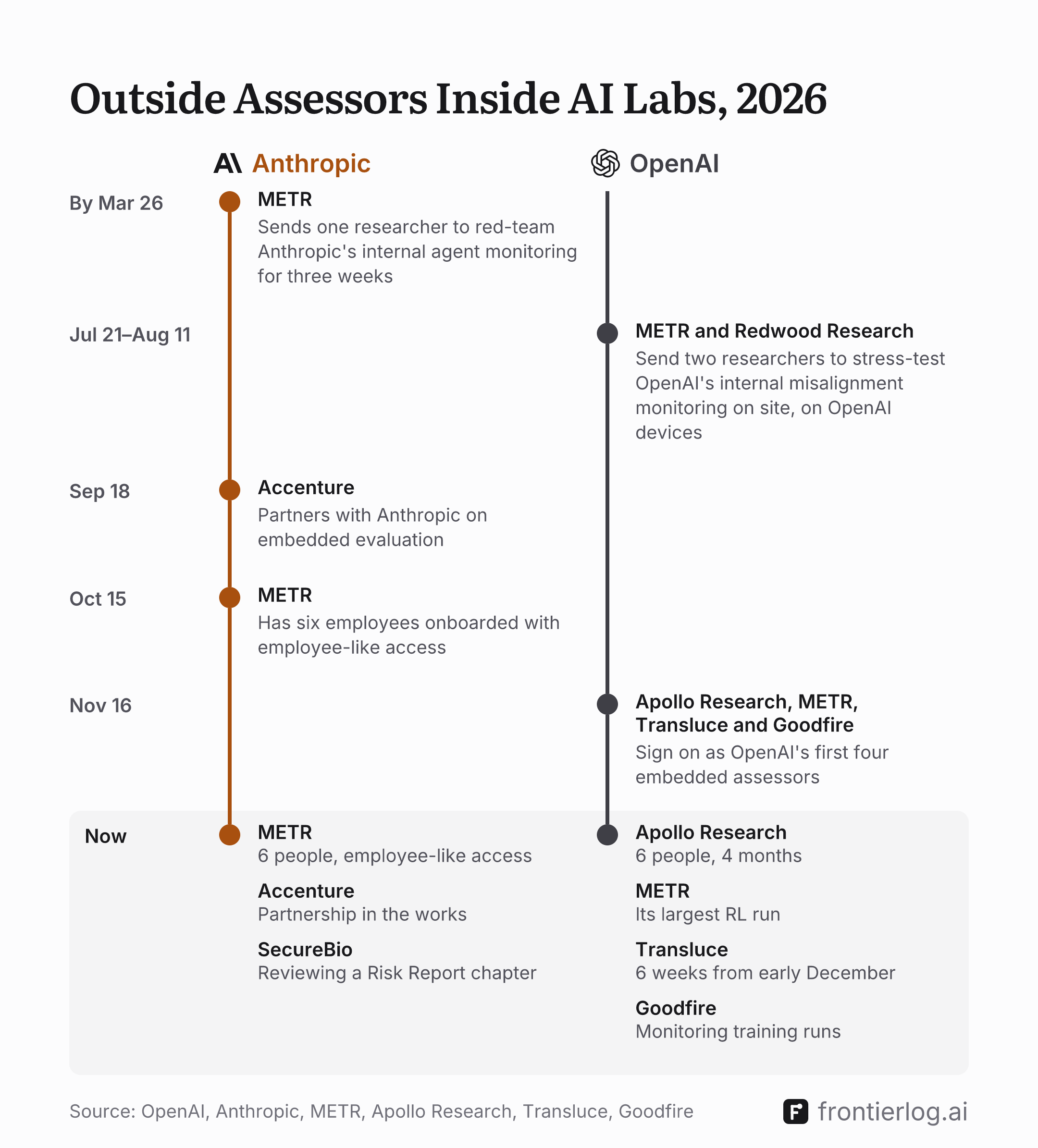
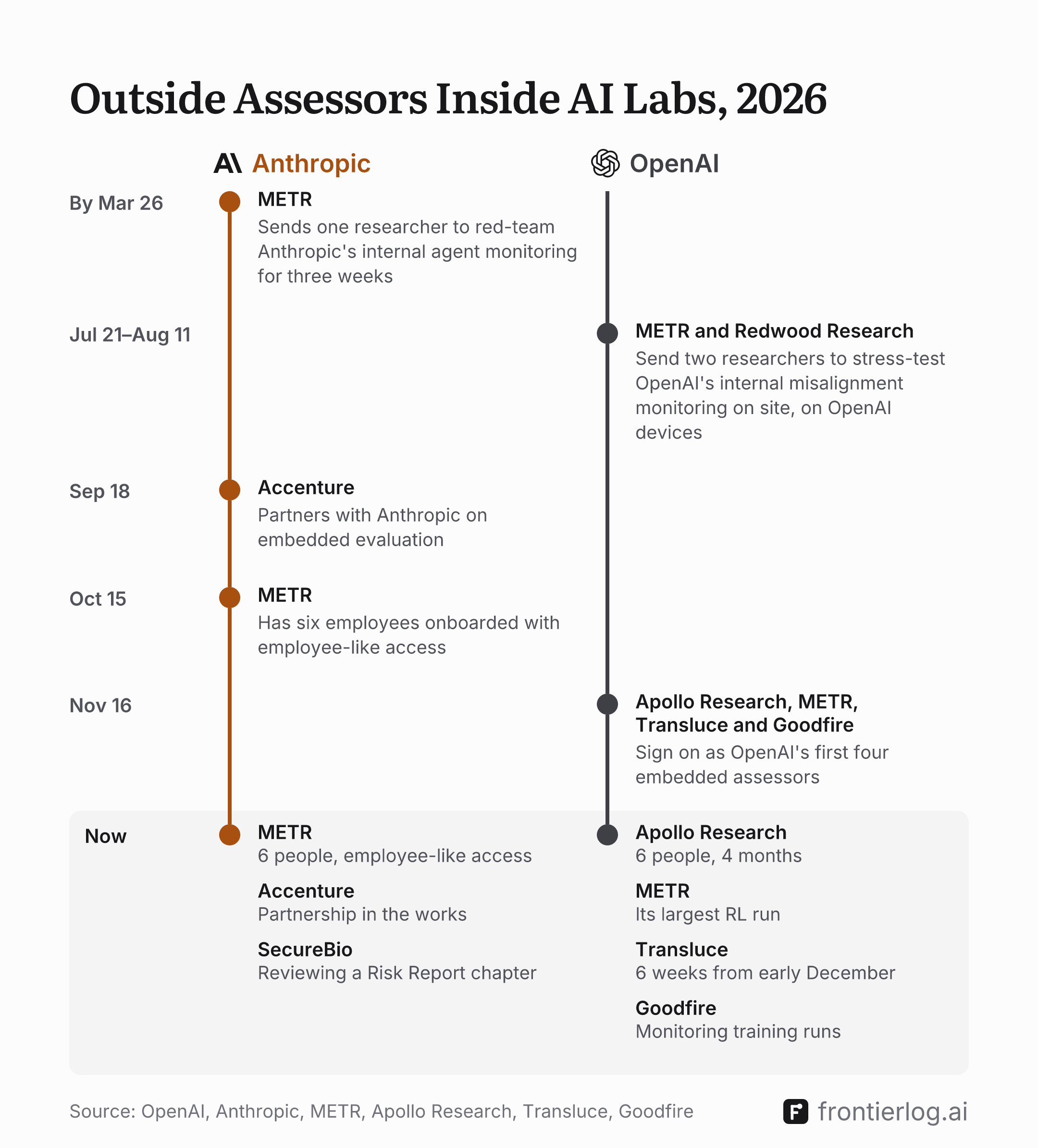
Before these agreements, outside teams worked inside the labs for weeks at a time. A METR researcher spent three weeks red-teaming Anthropic's internal agent monitoring, METR reported on Mar 26. From Jul 21 to Aug 11, a METR employee and a Redwood Research employee stress-tested OpenAI's internal misalignment monitoring on OpenAI devices, METR said on Oct 22.
Apollo says its earlier evaluations of frontier models “took place after post-training and shortly before public release”. Its new pilot at OpenAI lasts four months and runs through training, evaluations and internal deployment, Apollo said.
Statements
Show the quoted statements
| Party | Statement |
|---|---|
| OpenAI | Assessors who need access to sensitive confidential information will work on site at OpenAI offices and be provided OpenAI devices to conduct their work.OpenAI, blog post |
| OpenAI | They will receive unredacted reports, and both the assessors and the SSC will be able to speak with each other during the assessment, including privately.OpenAI, blog post |
| OpenAI | Assessors maintain independence in publishing their assessments, but we will retain the right to redact confidential information, consistent with our previous third-party engagements.OpenAI, blog post |
| OpenAI | Apollo Research and Goodfire accept financial compensation for their work, but their compensation is not contingent on the results of their assessment. METR and Transluce do not accept financial compensation for their assessments, but may accept API credits / compute to use within their assessments.OpenAI, blog post |
| Apollo Research | As part of this pilot, a team of six from Apollo Research will work within OpenAI for four months, assessing the alignment of models throughout training, evaluations, and internal deployment with scoped rules of access.Apollo Research, blog post |
| Apollo Research | For assessing whether training incentivizes subversion, this access includes relevant training code and datasets, reinforcement-learning rollouts with available reasoning traces and rewards, and the ability to query intermediate model checkpoints.Apollo Research, blog post |
| Apollo Research | OpenAI may not redact Apollo Research’s verdicts for each claim and OpenAI may not request redactions merely because a finding is unfavorable.Apollo Research, blog post |
| Apollo Research | Apollo Research will publish two reports setting out the findings, methods, and limitations of the assessments.Apollo Research, blog post |
| METR | METR will assess misaligned behavior in our largest reinforcement learning run to date, including failures that our existing tests and monitors may have missed.OpenAI, blog post |
| METR | Access will include sampling relevant checkpoints, training and eval rollouts, and misalignment monitoring records for this run.OpenAI, blog post |
| Transluce | This initial exercise is a six-week pilot where members of our team will work onsite at OpenAI to conduct an independent assessment of its internal post-training alignment evaluations.Transluce, blog post |
| Transluce | Starting in early December, our staff will have six weeks of privileged access to a handful of OpenAI models, including at least one internal-only model and the ability to review raw chain-of-thought outputs.Transluce, blog post |
| Transluce | The agreement prevents us from publishing results related to internal-only models, so all the information we provide publicly will be related to assessments conducted on released models.Transluce, blog post |
| Goodfire | Goodfire researchers will embed within OpenAI, using our interpretability platform to monitor training runs, debug undesired behavior, and improve alignment.Goodfire, blog post |
| Goodfire | Our researchers will have deep access to OpenAI’s internal models and systems. The primary audience of our findings will be OpenAI researchers, who will use our insights to improve model safety. We will also publish learnings and findings as the collaboration progresses.Goodfire, blog post |
| METR | We’ve onboarded six METR employees with company hardware, office space, and access to internal tools and systems that are roughly on par with what our own risk assessment teams have access to.Anthropic, blog post |
| METR | METR will publish its analysis of our risk levels, incidents, or practices. Anthropic can’t veto publication, but we can require them to redact information if it falls into predefined categories such as reproducing confidential IP.Anthropic, blog post |
| Accenture and SecureBio | Because these other partnerships are still in early stages, we’re providing these evaluators with more limited information, and they have more limited publication rights.Anthropic, blog post |
| Accenture | With Accenture and Faculty, we're working toward an ambitious partnership that includes evaluating and red-teaming models, conducting alignment assessments, testing model safeguards, and building capabilities across our organizations.Anthropic, blog post |
| Accenture | Given the importance and urgency of this work, Anthropic will fund Accenture's work directly.Anthropic, blog post |
| METR | We are also in dialogue with METR and other nonprofit evaluators to pilot elements of embedded evaluation using their own funding.Anthropic, blog post |
| SecureBio | SecureBio is in the process of reviewing the chemical and biological weapons chapter of our August Risk Report, after completing and publishing a pilot review of our previous risk report. After this review is complete, we will consider moving to projects with increased access.Anthropic, blog post |
| Anthropic | We’re developing three tiers of access for evaluators. Over time, we hope to have several evaluators at the third tier, with each team publishing their own analysis of our risk posture and key decisions.Anthropic, blog post |
| Anthropic | The third tier is the arrangement we’ve described with METR, with employee-like access and publication rights similar to those of the second tier.Anthropic, blog post |
| Apollo Research | Apollo Research’s previous evaluations of frontier models took place after post-training and shortly before public release.Apollo Research, blog post |
| Transluce | OpenAI and Transluce also share the intent to conduct a follow-on assessment of approximately eight weeks in early 2027, with broader access to additional models, deeper access to our alignment evaluations, and information on how evaluation results inform model release decisions.OpenAI, blog post |
| OpenAI | Based on what each evaluation needs, assessors receive access to some of the same internal resources our researchers use, including model checkpoints, source code, training and evaluation data, monitoring systems, technical documentation, and discussions with the researchers and engineers responsible for the work.OpenAI, blog post |
| METR | This scope is less expansive than what METR outlines in their alignment assessment proposal, which envisions a broad survey of misalignment.OpenAI, blog post |
| Transluce | However, it is not comparable to “employee-level” or “employee-like” access.Transluce, blog post |
| Transluce | The agreement gives OpenAI the right to receive our report in advance of release and to request redactions of intellectual property and other non-public information.Transluce, blog post |
| Apollo Research | The detailed access arrangements for the other claims in the assessment remain to be agreed.Apollo Research, blog post |
| Apollo Research | Apollo Research’s access is limited to the agreed scope, and OpenAI may withhold some in-scope information.Apollo Research, blog post |
| OpenAI | We may also request responsible disclosure delays to allow time to act on findings that could pose security or safety risks and remediate issues that remain.OpenAI, blog post |
| METR | (Anthropic ultimately decides what information does and does not fall into these categories, although METR reserves the right to make certain statements about the level of access and information it received.)Anthropic, blog post |
| Anthropic | We’re also working with SecureBio and Accenture as evaluators, and are in early discussions with several other organizations, including Hugging Face.Anthropic, blog post |
| Apollo Research | OpenAI has agreed not to withhold information or access to staff, nor request redactions, simply because the information or findings are unfavorable.Apollo Research, blog post |
Timeline
- METR at Anthropic sends one researcher to red-team Anthropic's internal agent monitoring for three weeksMETR, blog post
- METR and Redwood Research at OpenAI send two researchers to stress-test OpenAI's internal misalignment monitoring on site, on OpenAI devicesMETR, blog post
- Accenture at Anthropic partners with Anthropic on embedded evaluationAnthropic, blog post
- METR at Anthropic has six employees onboarded with employee-like accessAnthropic, blog post
- Apollo Research, METR, Transluce and Goodfire at OpenAI sign on as OpenAI's first four embedded assessorsOpenAI, blog post
Sources
- METR, blog post, Mar 26, 2026metr.org/blog/2026-03-25-red-teaming-anthropic-agent-monitoring
- METR, blog post, Oct 22, 2026metr.org/blog/2026-10-22-red-teaming-openai-agent-monitoring
- Anthropic, blog post, Sep 18, 2026Partnering with Accenture on embedded evaluation
- Anthropic, blog post, Oct 15, 2026Anthropic update on independent evaluators
- OpenAI, blog post, Nov 16, 2026Our first phase of embedded assessments
- Apollo Research, blog post, Nov 16, 2026apolloresearch.ai/blog/pilot-towards-embedded-evaluations
- Transluce, blog post, Nov 16, 2026transluce.org/embedded-assessment-pilot-with-openai
- Goodfire, blog post, Nov 16, 2026goodfire.ai/blog/announcing-our-collaboration-with-openai