Anthropic and OpenAI on AI and Jobs
Eleven 2026 Anthropic and OpenAI studies on AI and jobs. Anthropic's customers report few domestic AI layoffs but less hiring. OpenAI maps how jobs may shift.
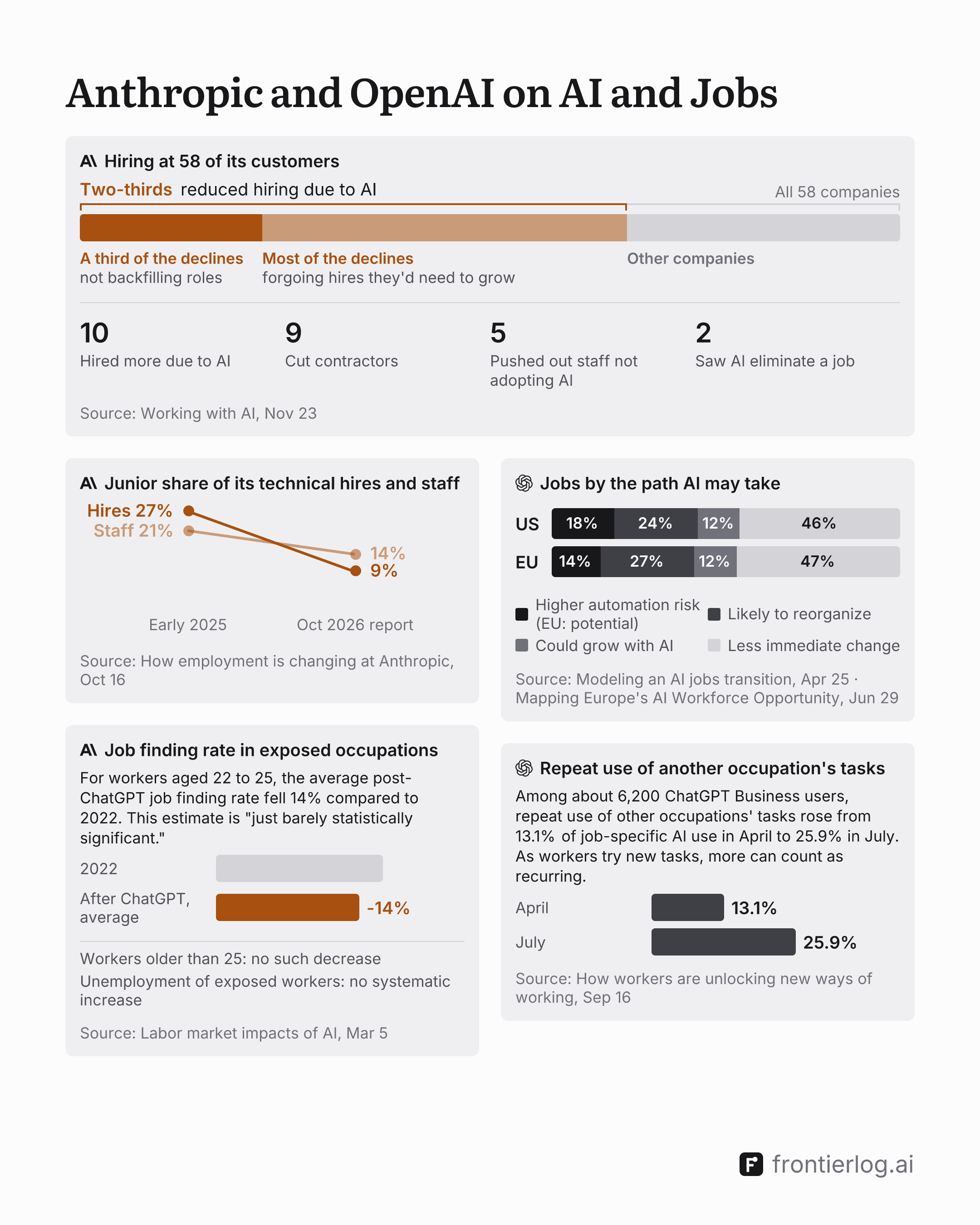
This story covers 11 studies on AI and jobs that Anthropic and OpenAI published in 2026. The newest, Anthropic's Working with AI on Nov 23, drew on interviews at 58 of its enterprise customers. Its authors saw "very few examples of domestic layoffs that were driven by AI automation". But people at two-thirds of the companies "reported reduced hiring due to AI".
Few layoffs, less hiring at Anthropic's customers
The 66 interviews covered 58 US companies. They ranged from AI-native startups to 100-year-old businesses. Anthropic picked them for their range across industry, size and AI use, and it says they "are not a random or systematically representative sample". A third of the hiring declines came from shrinking functions "through attrition without backfilling the roles". Most came from companies forgoing hires they would have needed to grow. Only some of the companies Anthropic contacted agreed to take part.
People at five companies described pushing out employees who would not adopt AI. People at two had seen AI automation "fully eliminate a position and lead to someone losing their job". Ten companies reported hiring more due to AI, mainly into AI implementation roles and IT support, and nine described cutting contractors, many of them offshore. The report doesn't say how these groups overlap.
Fewer junior hires inside Anthropic
On Oct 16, Anthropic reported on its own workforce from internal data and 17 employee interviews. Junior staff slipped from 21% to 14% of its technical departments since early 2025. "The proportion of junior technical hires fell even faster, from 27% to 9%," it said. Around a third of its ML managers and a fifth of its software engineering managers reported hiring less due to AI.
Young workers in exposed jobs
Anthropic's Mar 5 study matched its Claude usage data to the US Current Population Survey. It found "no systematic increase in unemployment for highly exposed workers since late 2022". For workers aged 22 to 25, the job finding rate in exposed occupations fell 14% after ChatGPT, against 2022. Anthropic says "this is just barely statistically significant". The unemployment rate for these young workers in exposed occupations is flat, it adds. Workers older than 25 showed no such drop.
Two Anthropic surveys asked about worries and expectations. A fifth of the 80,508 Claude users in a survey Anthropic reported on Apr 22 voiced concern about economic displacement, and early-career respondents did so more often. Its Oct 16 report covers an August survey of 10,980 US adults and 1,334 staff. It found that "over half of Anthropic staff expect AI to be able to do at least 80% of their current work by 2030, compared with 5% of US workers".
Anthropic's scenario explorer, listed on its Economics page on Sep 9, models jobs and unemployment to 2030. "In most scenarios, job reallocation and unemployment both stay within ranges history has seen before," it says. The exception, it says, is "if we see recursive self-improvement and rapid adoption, unemployment could spike to historic levels".
OpenAI maps how jobs may change
OpenAI's Apr 25 framework sorts 921 occupations, about 148 million US jobs, into four paths. It puts 18% of jobs at relatively high automation risk, 24% as likely to reorganize, 12% as able to grow with AI and 46% as showing less immediate change. "These categories are not predictions that a particular percentage of jobs will disappear," OpenAI says. Its Jun 29 EU version puts 14% of EU employment at higher automation potential.
Since the first quarter of 2024, the April post adds, "unemployment has risen more in some less-exposed occupations than in the occupations the framework classifies as facing the greatest AI risk". It says some changes "may appear first in hiring, entry-level opportunities, wages, or the composition of work rather than in layoffs".
OpenAI's three other studies measure tasks and job posts. In more than 800,000 US ChatGPT messages (Jul 27), 16.8% of work-related messages were about another occupation's tasks. Among about 6,200 ChatGPT Business users (Sep 16), tasks from other occupations that they had tried before rose from 13.1% to 25.9% of their job-specific AI use between April and July. OpenAI notes that this count rises as workers try new tasks.
With Upwork, OpenAI compared 63 work categories (Nov 10) from 2023 to 2025. Work common in ChatGPT use tended to lose share of Upwork job posts, and less common work tended to gain. Of the 63 categories, 43 followed this pattern and 20 showed the reverse. "ChatGPT use alone does not explain changes in freelance demand," OpenAI adds.
Every study, its method and sample
| Study | Method and sample | Finding, in the lab's words |
|---|---|---|
| Anthropic, Mar 5: Labor market impacts of AI | US Current Population Survey data matched to Claude usage, about 800 occupations | "no systematic increase in unemployment for highly exposed workers since late 2022" |
| Anthropic, Apr 22: What 81,000 people told us about the economics of AI | Open-ended survey of 80,508 Claude users | "One fifth of the respondents in our survey voiced concern about economic displacement." |
| OpenAI, Apr 25: Modeling an AI jobs transition | Occupation model, 921 occupations and about 148 million US jobs | "These categories are not predictions that a particular percentage of jobs will disappear." |
| OpenAI, Jun 29: Mapping Europe's AI Workforce Opportunity | The same model on EU employment, with ESCO and Eurostat data | "About 14% is in occupations with relatively higher near-term automation potential." |
| OpenAI, Jul 27: How AI is expanding what people do at work | More than 800,000 messages from US ChatGPT users | "16.8% of work-related messages and 43.5% of occupation-specific messages are about tasks associated with another occupation" |
| Anthropic, Sep 9: Scenarios for our economic future | Economic model of the US to 2030, three scenarios | "in most scenarios, job reallocation and unemployment both stay within ranges history has seen before, with one exception" |
| OpenAI, Sep 16: How workers are unlocking new ways of working | More than 1.5 million ChatGPT messages, about 6,200 workers followed April to July | "previously used cross-occupation tasks increased from 13.1% of occupation-specific AI activity in April to 25.9% in July" |
| Anthropic, Oct 16: How employment is changing at Anthropic | Internal company data and 17 employee interviews | "The proportion of junior technical hires fell even faster, from 27% to 9%." |
| Anthropic, Oct 16: The AI expectations gap | Surveys of 10,980 US adults and 1,334 Anthropic staff | "over half of Anthropic staff expect AI to be able to do at least 80% of their current work by 2030, compared with 5% of US workers" |
| OpenAI, Nov 10: AI's effect on freelance work | Upwork job posts and ChatGPT use, 63 work categories | "Many activities that were relatively common in ChatGPT lost share on Upwork, while less common activities gained share." |
| Anthropic, Nov 23: Working with AI | 66 interviews at 58 enterprise customers | "People at two-thirds of the companies we spoke to reported reduced hiring due to AI" |
Anthropic · Hiring at 58 of its customers
| Model | Value | Sources |
|---|---|---|
| Working with AIHired more due to AI | 10 companies | Working with AITop-down automation section, paragraph beginning 'These cases were rare': '10 companies reported hiring more due to AI' |
| Working with AICut contractors | 9 companies | Working with AITop-down automation section, paragraph beginning 'Beyond terminations': 'nine companies described cutting contracted software developers' |
| Working with AIPushed out staff not adopting AI | 5 companies | Working with AITop-down automation section, paragraph beginning 'These cases were rare': 'people at five companies described pushing out employees who would not adopt AI' |
| Working with AISaw AI eliminate a job | 2 companies | Working with AITop-down automation section, paragraph beginning 'These cases were rare': 'only two had seen AI automation fully eliminate a position and lead to someone losing their job' |
Anthropic · Junior share of its technical hires and staff
| Model | Value | Sources |
|---|---|---|
| How employment is changing at AnthropicHires, early 2025 | 27% | How employment is changing at AnthropicParagraph beginning 'The shift in employment shares': 'The proportion of junior technical hires fell even faster, from 27% to 9%' |
| How employment is changing at AnthropicHires, latest | 9% | How employment is changing at AnthropicParagraph beginning 'The shift in employment shares': 'The proportion of junior technical hires fell even faster, from 27% to 9%' |
| How employment is changing at AnthropicStaff, early 2025 | 21% | How employment is changing at AnthropicParagraph beginning 'The shift in employment shares': 'the share of junior-level employees in technical departments at Anthropic slipped from 21% to 14% since early 2025' |
| How employment is changing at AnthropicStaff, latest | 14% | How employment is changing at AnthropicParagraph beginning 'The shift in employment shares': 'the share of junior-level employees in technical departments at Anthropic slipped from 21% to 14% since early 2025' |
Anthropic · Job finding rate in exposed occupations
| Model | Value | Sources |
|---|---|---|
| Labor market impacts of AIWorkers aged 22 to 25, since ChatGPT against 2022 | -14% | Labor market impacts of AI: A new measureParagraph beginning 'Apart from some large swings': 'The averaged estimate in the post-ChatGPT era is a 14% drop in the job finding rate compared to that in 2022 in the exposed occupations' |
OpenAI · Jobs by the path AI may take
OpenAI · Repeat use of another occupation's tasks
| Model | Value | Sources |
|---|---|---|
| How workers are unlocking new ways of workingApril | 13.1% | How workers are unlocking new ways of workingSection 'Cross-occupation tasks can become recurring parts of new AI workflows': 'increased from 13.1% of occupation-specific AI activity in April to 25.9% in July' |
| How workers are unlocking new ways of workingJuly | 25.9% | How workers are unlocking new ways of workingSection 'Cross-occupation tasks can become recurring parts of new AI workflows': 'increased from 13.1% of occupation-specific AI activity in April to 25.9% in July' |
Timeline
- Anthropic finds no systematic rise in unemployment for workers most exposed to AI, and suggestive evidence of slower hiring of younger workers in those jobsAnthropic, research post
- Anthropic reports that a fifth of 80,508 surveyed Claude users voiced concern about losing work to AIAnthropic, research post
- OpenAI maps 921 US occupations into four paths and says the shares aren't job-loss forecastsOpenAI, research post
- OpenAI applies the same framework to EU employmentOpenAI, research post
- OpenAI finds that ChatGPT users often ask for help with another occupation's tasksOpenAI, research post
- Anthropic publishes a model of jobs, growth and unemployment to 2030Anthropic, scenario explorer
- OpenAI finds that workers return to tasks outside their occupationOpenAI, research post
- Anthropic reports that junior roles fell from 27% to 9% of its own technical hiresAnthropic, research post
- Anthropic compares what US workers and its own staff expect AI to do by 2030Anthropic, research post
- OpenAI finds, with Upwork, that in 43 of 63 work categories, work common in ChatGPT use lost share of freelance job posts or less common work gainedOpenAI, research post
- Anthropic finds very few AI-driven domestic layoffs among 58 enterprise customers, but reduced hiring at two-thirds of themAnthropic, research report
Sources
- Anthropic, research post, Mar 5, 2026Labor market impacts of AI: A new measure
- Anthropic, research post, Apr 22, 2026What 81,000 people told us about AI economics
- Anthropic, Economics team indexanthropic.com/research/team/economics
- Anthropic, scenario exploreranthropic.com/institute/econ-scenarios
- Anthropic, research post, Oct 16, 2026How employment is changing at Anthropic
- Anthropic, research post, Oct 16, 2026The AI expectations gap
- Anthropic, research report, Nov 23, 2026Working with AI
- OpenAI, research post, Apr 25, 2026openai.com/index/modeling-ai-jobs-transition
- OpenAI, research post, Jun 29, 2026openai.com/index/mapping-ai-jobs-transition-eu
- OpenAI, research post, Jul 27, 2026openai.com/index/how-ai-is-expanding-what-people-do-at-work
- OpenAI, research post, Sep 16, 2026openai.com/index/unlocking-new-ways-of-working
- OpenAI, research post, Nov 10, 2026openai.com/index/ai-effect-on-freelance-work