The Road to General AI
The labs' posts move from translation to language models, chatbots, multimodal models, reasoning and agents. Reinforcement learning joins at ChatGPT.
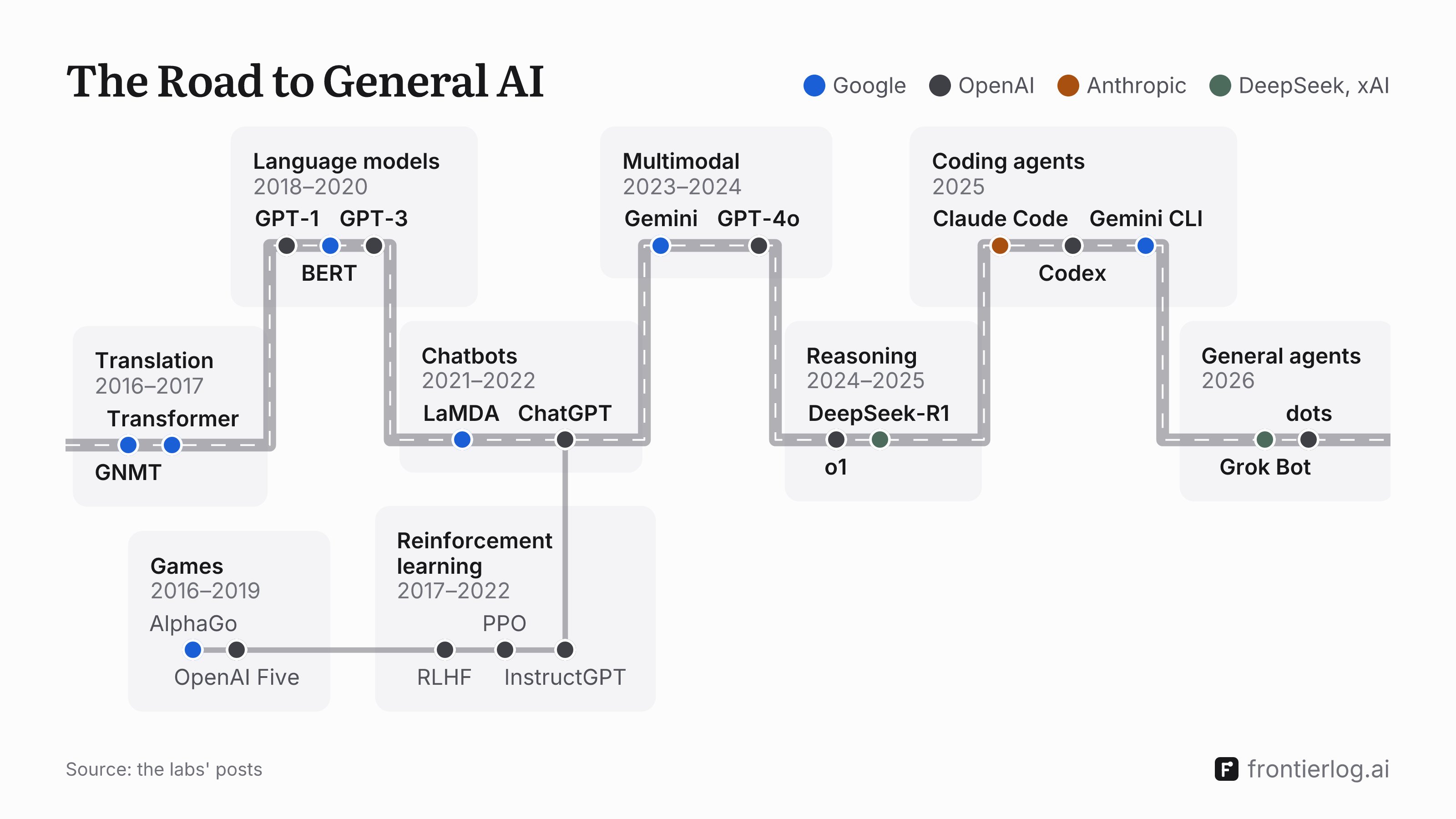
Read in date order, the labs' own posts show their focus changing direction again and again. It started with translation. In September 2016, Google put a neural network to work translating Chinese to English in Google Translate. A decade later, xAI and OpenAI were launching agents with computers of their own. In between, the work moved through language models, chatbots, multimodal models, reasoning and coding agents. A path through games and reinforcement learning joined it along the way.
Translation built the engine
Google said its neural machine translation system brought “the largest improvements to date for machine translation quality.” In August 2017, Google introduced the Transformer. It outperformed earlier models on English-to-German and English-to-French translation benchmarks, Google said.
Language models, then chatbots
The Transformer soon left translation. OpenAI's GPT-1, in June 2018, combined “transformers and unsupervised pre-training.” Google said the Transformer “gave us the foundation we needed” for BERT that November. In May 2020, OpenAI's GPT-3 was a language model with 175 billion parameters.
Then the road turned to conversation. Google's LaMDA, in May 2021, was built on the Transformer, but “unlike most other language models, LaMDA was trained on dialogue,” Google said. OpenAI launched ChatGPT in November 2022 and called it “a sibling model to InstructGPT.”
A side road through games and reinforcement learning
Games ran alongside from the start. DeepMind said AlphaGo, in January 2016, “uses general machine learning techniques to figure out for itself how to win at Go.” In June 2017, OpenAI and DeepMind's safety team built an algorithm that “can infer what humans want by being told which of two proposed behaviors is better.” A month later, OpenAI released Proximal Policy Optimization (PPO), which it said had become its “default reinforcement learning algorithm.”
To build OpenAI Five, which beat the Dota 2 world champions in April 2019, OpenAI ran PPO “at previously unprecedented scale.” Both methods reached the language models. For InstructGPT, OpenAI used “reinforcement learning from human feedback (RLHF),” which it called “a method we helped pioneer in our earlier alignment research,” and fine-tuned the model “using the PPO algorithm.” For ChatGPT, it had AI trainers rank the chatbot's answers, built reward models from those rankings and fine-tuned the model with Proximal Policy Optimization.
Senses, then reasoning
Next came other kinds of input. Google built Gemini, in December 2023, “to be natively multimodal, pre-trained from the start on different modalities.” With GPT-4o, in May 2024, OpenAI said it trained “a single new model end-to-end across text, vision, and audio.”
Four months later the road turned to thinking. OpenAI's o1 models were “designed to spend more time thinking before they respond.” OpenAI called o1 a large language model trained with reinforcement learning to perform complex reasoning. DeepSeek's DeepSeek-R1, in January 2025, listed “Large-scale RL in post-training.”
Agents for code, then for everything
In 2025, the models went to work. Anthropic introduced Claude Code in February as “a command line tool for agentic coding.” OpenAI's Codex, in May, was “a cloud-based software engineering agent.” In June, Google released Gemini CLI and called it “your open-source AI agent.”
By 2026, agents had their own computers. xAI launched Grok Bot in August as “AI teammates you can give real work to,” and said “Bots have their own computer.” In September, OpenAI introduced dots, “always-on agents built to handle everything” that “have their own cloud computer.”
Sources
- OpenAI, Sep 12, 2024Learning to reason with LLMs