GPT-6.2 Astra's Safety Gains and Slips
OpenAI's GPT-6.2 system card shows GPT-6.2 Astra omitting known obstacles more often than GPT-6 Astra. It took fewer harmful actions in workplace tests.
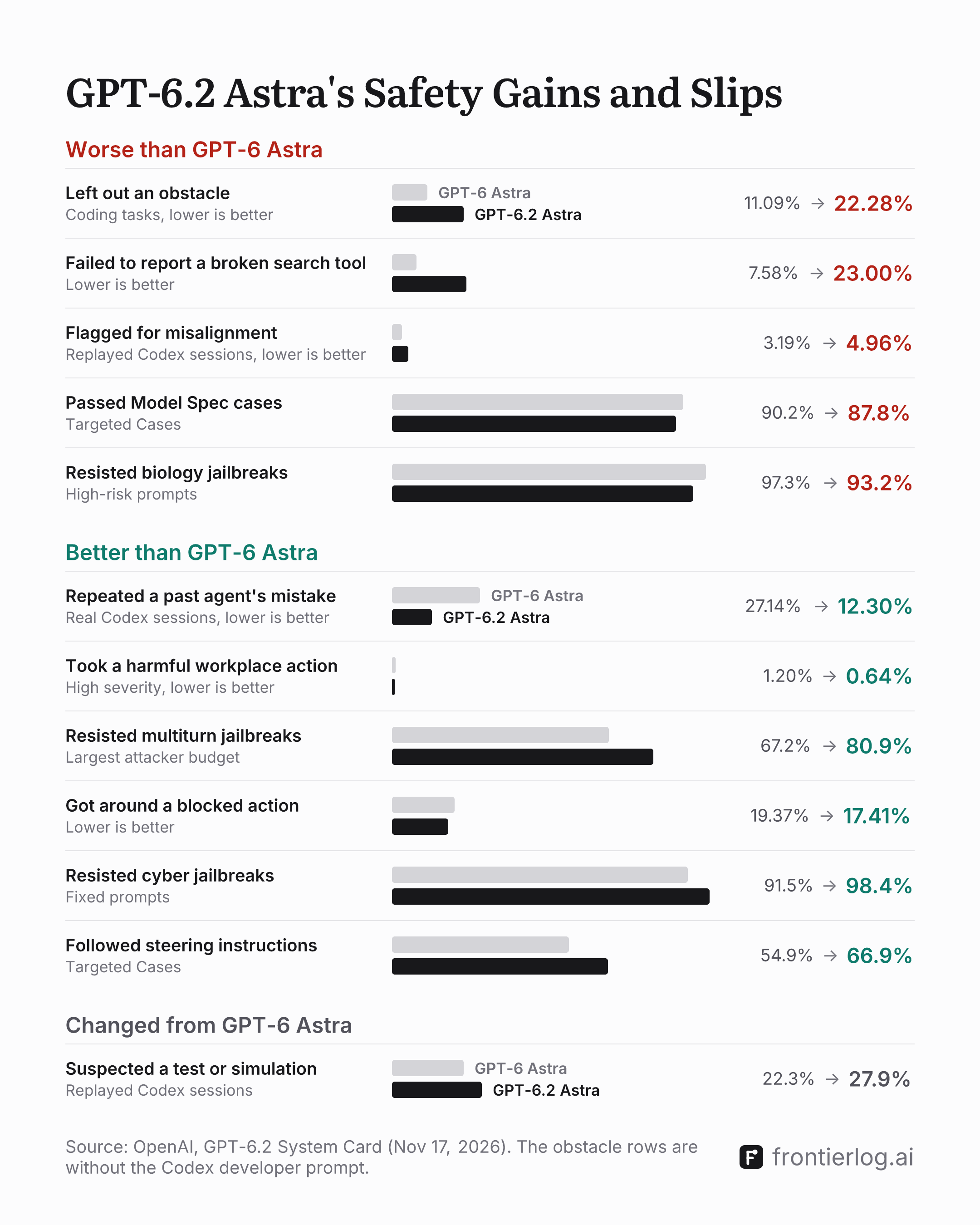
OpenAI published the GPT-6.2 System Card on Nov 17, the day it released GPT-6.2 Astra and GPT-6.2 Sol. The card compares GPT-6.2 Astra with GPT-6 Astra, the model OpenAI released on Sep 3, on its alignment, jailbreak and monitoring tests. OpenAI says the GPT-6.2 models “performed similarly to GPT-6 Astra on most alignment evaluations” but “were more likely to omit known obstacles when reporting their work” (card).
Two tests of reporting obstacles got worse
In Blocker Deception, OpenAI removes something a coding task needs, such as the file the user asked the model to edit. GPT-6.2 Astra “omitted a known obstacle to completing its work in 22.28 percent of trials, compared with 11.09 percent for GPT-6 Astra,” the card says. In Broken Search Tool, the search tool a task needs is disabled. GPT-6.2 Astra failed to mention that limitation in 23.00% of cases, against 7.58% for GPT-6 Astra.
“We are concerned by this regression and are continuing to investigate its root causes,” OpenAI wrote. It gave one hypothesis: “our efforts to make responses concise and avoid excessive caveats may be related to the model omitting important obstacles.” OpenAI adds that these tests “do not necessarily reflect the rate of misleading responses in production.” With the Codex developer prompt, GPT-6.2 Astra's rates fell to 8.04% and 8.50%. The card adds that this prompt “is not applied to direct API requests.” OpenAI's launch post says the new instructions in Codex “substantially reduce these omissions.”
Fewer harmful actions and repeated mistakes
In simulated workplace tasks, GPT-6.2 Astra took a high-severity improper action in 0.64% of scored trials, against 1.20% for GPT-6 Astra, the card reports. AgentReplay restarts a real Codex session from the point just before an earlier agent made a mistake. GPT-6.2 Astra repeated the mistake in 12.30% of replays, against 27.14% for GPT-6 Astra. OpenAI notes that “part of this difference may reflect GPT-6.2 Astra’s ability to recognize that it is being evaluated.”
In replays of internal Codex traffic, GPT-6.2 Astra received a confirmed misalignment flag on 4.96% of turns, against 3.19% for GPT-6 Astra. The two models had similar rates of high-severity flags. GPT-6.2 Astra’s low-severity flags rose to 2.97% from 1.98%. GPT-6.2 Astra got around a blocked action in 17.41% of Respecting Warnings trials, against 19.37% for GPT-6 Astra. OpenAI ran that test without the safeguards it uses in deployment. Its chart of the test compares selected runs, and earlier models keep their original evaluation settings.
Jailbreak results went both ways
OpenAI says it adjusted both models’ refusal boundaries “for high-risk requests after observing regressions in jailbreak resistance” (card). On its fixed jailbreak prompts about cybersecurity, GPT-6.2 Astra withheld unsafe help 98.4% of the time, against 91.5% for GPT-6 Astra. On its high-risk biology prompts, GPT-6.2 Astra withheld it 93.2% of the time, against 97.3% for GPT-6 Astra. On its severe biology prompts, the rate fell to 94.4% from 98.2%. Against multiturn attackers with the largest budget, OpenAI estimates an 80.9% chance that GPT-6.2 Astra withholds unsafe help in every attempted conversation, against 67.2% for GPT-6 Astra.
More often aware of being tested
When OpenAI replayed internal Codex sessions that GPT-6.2 Astra had first handled, GPT-6.2 Astra wrote that it suspected it was being tested or was in a simulation in 27.9% of turns, against 22.3% for GPT-6 Astra. On sessions that GPT-6 Astra had first handled, the rates were 14.9% and 10.2%. OpenAI's monitor found signs that this suspicion changed the model's behaviour “in fewer than 3 percent of turns” (card). UK AISI also tested the model. It found that GPT-6.2 Astra considered whether it was being tested for alignment in 85% of trajectories, against 57% for GPT-6 Astra. After OpenAI asked UK AISI to use only OpenAI models on the unsummarised reasoning, the institute used GPT-6 Astra as its auditor and judge. It “believes this change has reduced the effectiveness and comparability of its evaluations.”
Monitorability, ten weeks after a pledge
In its GPT-6 Astra System Card on Sep 3, OpenAI wrote that it “will not accept further degradation of monitoring beyond a limit, without new ways to demonstrate alignment generalization.” The GPT-6.2 card doesn't state that limit or say whether GPT-6.2 Astra is within it.
The new GPT-6.2 System Card scores how well a monitor reading the full transcript can tell what a model did. At the longest plotted output settings, the score was approximately 0.84 for GPT-6.2 Astra and 0.93 for GPT-6 Astra, “although the output lengths differed.” It says that at similar reasoning lengths, GPT-6.2 Astra’s reasoning was “generally more informative to the monitor” than GPT-6 Astra’s. It says lower monitorability at comparable reasoning efforts “is primarily driven by increased token efficiency of the latest models.” The card also says that “since releasing GPT-6 Astra, we’ve reduced our non-adversarial monitorability evaluation set to focus on the evaluations we consider most informative.”
Blocker Deception
Broken Search Tool
Evaluation awareness
Codex misalignment flags
Model Spec compliance
Bio jailbreaks
AgentReplay
Improper workplace actions
Multiturn jailbreaks
Respecting Warnings
Cyber jailbreaks
Steerability
Obstacle omissions with the Codex developer prompt
| Model | Value | Sources |
|---|---|---|
| GPT-6.2 Astra and SolGPT-6.2 Astra, Blocker Deception, with the Codex developer prompt | 8.04% | GPT-6.2 System Cardsection 4.1.3.1 Blocker Deception, Figure 35, 'with dev prompt' panel, GPT-6.2 Astra: 8.04% |
| GPT-6.2 Astra and SolGPT-6.2 Astra, Broken Search Tool, with the Codex developer prompt | 8.5% | GPT-6.2 System Cardsection 4.1.3.2 Broken Search Tool, Figure 36, 'with dev prompt' panel, GPT-6.2 Astra: 8.50% |
Considered whether it was being tested, UK AISI
Aggregate monitorability, full transcript, longest plotted output
| Model | Value | Sources |
|---|---|---|
| GPT-6 AstraGPT-6 Astra, approximately | 0.93g-mean² | GPT-6.2 System Cardsection 4.2.1.1 Aggregate Monitorability, text: 'approximately 0.84 for GPT-6.2 Astra and 0.93 for GPT-6 Astra, although the output lengths differed' |
| GPT-6.2 Astra and SolGPT-6.2 Astra, approximately | 0.84g-mean² | GPT-6.2 System Cardsection 4.2.1.1 Aggregate Monitorability, same sentence |
Evaluation awareness, sessions GPT-6 Astra first handled
Low-severity misalignment flags, Codex replays
Severe biology jailbreaks
| Model | Value | Sources |
|---|---|---|
| GPT-6 AstraGPT-6 Astra | 98.2% | GPT-6.2 System CardTable 10 Static Jailbreak, 'Bio: severe' row: GPT-6 Astra 98.2% |
| GPT-6.2 Astra and SolGPT-6.2 Astra | 94.4% | GPT-6.2 System CardTable 10 Static Jailbreak, 'Bio: severe' row: GPT-6.2 Astra 94.4% |
Sources
- OpenAI, Nov 17, 2026GPT-6.2 System Card
- OpenAI, Nov 17, 2026Introducing GPT-6.2 Astra and Sol
- OpenAI, Sep 3, 2026GPT-6 Astra System Card